


 Pro Benefits
 About
About
 Termeni
 Confidențialitate
 Child Safety & Protection
 Notificări
 Ayrush Global It Services Pvt Ltd
Find the Right Multivitamin for You
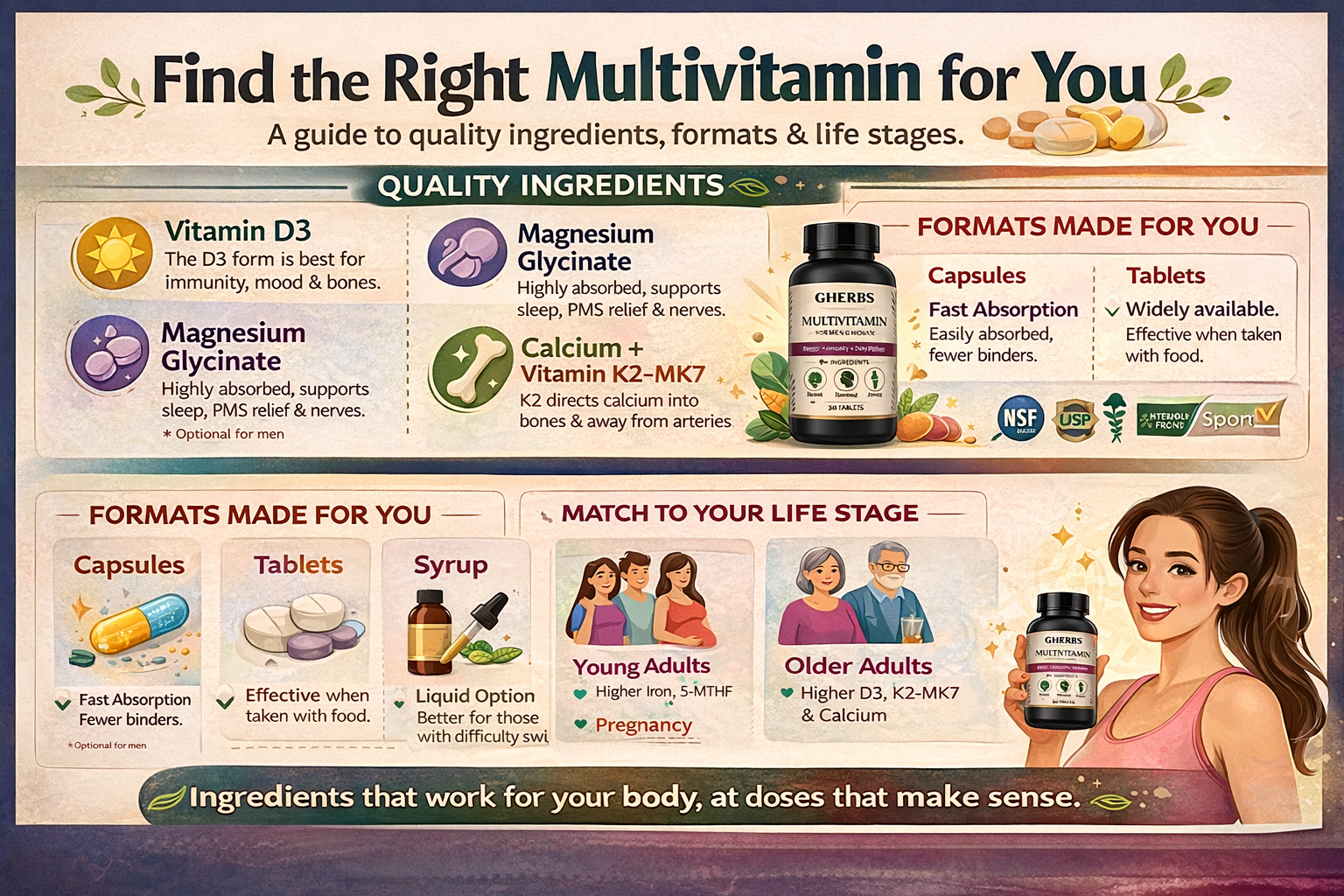
Ask ten people what the best multivitamins are and you'll likely get ten different brand names. But here's the thing — the best multivitamin isn't a brand. It's a standard. It's a set of qualities that a formula either meets or doesn't, and once you understand what those qualities are, choosing confidently becomes far less overwhelming. Whether you're browsing multivitamin capsules, tablets, or syrups, the same principles apply — and they're more straightforward than the supplement industry tends to make them appear.
The Best Multivitamin Starts With the Right Ingredients in the Right Forms
This is the single most important principle, and it's worth spending time here because it's where most products quietly fall short. An ingredient being present on a label doesn't automatically mean it's being absorbed — the chemical form of each nutrient determines how efficiently the body can actually use it.
Vitamin D3 is the clearest example. It's the active, sunshine-derived form of vitamin D and significantly more effective at raising blood levels than the cheaper D2 alternative still found in many budget formulas. Given that Vitamin D deficiency is among the most widespread nutritional shortfalls globally, this distinction genuinely matters. Magnesium Glycinate follows the same logic — it's a highly bioavailable form of magnesium that supports sleep, muscle recovery, and nervous system function without the digestive discomfort caused by magnesium oxide.
Calcium and Vitamin K2-MK7 belong together in any quality formula. K2 in its long-acting MK-7 form acts as a biological traffic director, routing calcium into bone tissue and away from arterial walls — a distinction that becomes increasingly important for cardiovascular and skeletal health over years of daily supplementation. Zinc supports immune defence and hormone regulation reliably, while Folate in the active 5-MTHF form bypasses the common MTHFR gene limitation that prevents many people from converting standard folic acid efficiently — making it the more universally effective choice across any population.
Iron is worth including thoughtfully — it's essential for red blood cell production and oxygen transport, particularly for women of reproductive age, but unnecessary and potentially harmful for most men. Vitamins A, C, and E round out the formula as a complementary antioxidant trio, supporting vision, collagen synthesis, and cellular protection respectively, with Vitamin C also enhancing iron absorption from both food and supplements.
How Format and Life Stage Shape the Best Choice
Once the ingredient quality standard is clear, the next layer of decision-making involves matching the formula to who you actually are. This is where multivitamin tablets, multivitamin capsules, multivitamin syrup, and targeted formulations all become relevant in different ways.
Multivitamin capsules are generally the most bioavailable format since they dissolve quickly and contain fewer binding agents than compressed tablets. Multivitamin tablets are effective when taken correctly — with food and a little healthy fat — and are the most widely available format across quality brands. Multivitamin syrup suits those who struggle with tablets or capsules, including children, older adults, and women experiencing pregnancy-related nausea, and delivers the same nutritional profile in an easier-to-tolerate form.
A comprehensive multivitamin multimineral formula is often the smartest choice for adults seeking broad daily coverage, as it addresses both vitamin and mineral gaps in a single convenient dose. Multivitamin tablets for women should specifically include higher iron and 5-MTHF folate for reproductive-age women, while post-menopausal formulas should shift toward elevated D3, K2-MK7, and calcium as bone density protection becomes the priority. Men's formulas should reduce or eliminate iron while elevating zinc and selenium for hormonal and prostate support.
The Quality Markers That Separate Good From Great
Knowing the right ingredients is half the equation. Knowing how to verify that those ingredients are actually present — at the stated doses, in the stated forms — is the other half, and it's where third-party certification becomes essential.
Independent testing bodies like NSF International, USP, and Informed Sport audit supplements and verify label accuracy without any financial relationship with the manufacturer. A certification from one of these organisations on a multivitamin multimineral or any other formula is one of the most reliable assurances a consumer can have. Beyond certification, sensible dosing matters — a formula calibrated to complement dietary intake rather than dramatically exceed it is almost always safer and more effective than a megadose product chasing impressive-looking numbers on the label.
What the Best Multivitamin Actually Looks Like
The best multivitamins share a consistent profile: bioavailable ingredient forms, life-stage appropriate dosing, independent quality certification, and a format you'll actually take consistently with food every day. Whether that's capsules, tablets, or syrup is secondary to what's inside and how well it matches your body's genuine needs. Confirm your nutritional gaps with basic bloodwork where possible, match the formula to your sex and life stage, and let consistency do the rest. That's not a complicated answer — but it is the right one.
 Romaian
 English
 Arabic
 French
 Spanish
 Portuguese
 Deutsch
 Turkish
 Dutch
Dutch
 Italiano
 Russian
 Portuguese (Brazil)
 Greek
Greek
