


 Pro Benefits
 About
About
 Términos
 Privacidad
 Child Safety & Protection
 Notificaciones
 Ayrush Global It Services Pvt Ltd
Can PWP MBA Programs Help You Become a Future Business Leader?
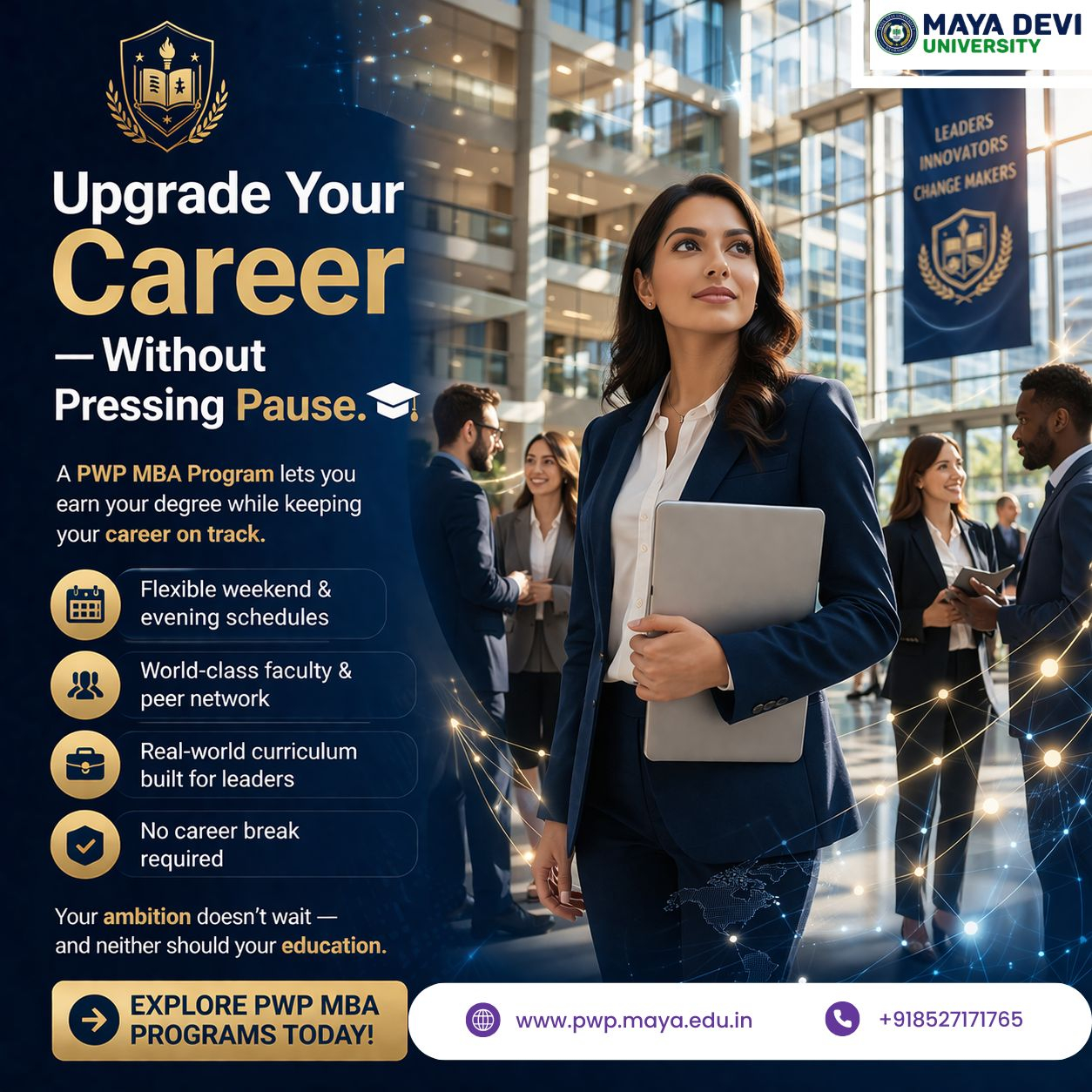
Leadership is not given. It is grown — through years of navigating difficult decisions, managing people through uncertainty, and slowly learning how organisations actually function beneath the surface. Most working professionals in India already have more of this raw material than they realise. What they often lack is the formal structure that converts years of experience into the strategic clarity, cross-functional fluency, and business confidence that defines a recognised leader.
That structure is exactly what PWP MBA programs are built to provide.
In India's corporate landscape of 2026, the path to business leadership has become both more competitive and more accessible at the same time. More competitive because organisations are raising the bar on what they expect from their senior leaders. More accessible because PWP MBA programs — designed specifically for employed professionals — have removed the biggest historical barrier: the need to abandon your career in order to invest in it.
This blog makes the case, clearly and in detail, for how PWP MBA programs develop future business leaders. It covers the specific leadership competencies these programmes build, the five MBA specialisations most aligned with India's growth sectors, the real career outcomes working professionals experience after graduation, and what to look for when choosing the right programme. If your ambition is to lead — not just perform — read on.
What Business Leadership Actually Demands in India Today
To understand how PWP MBA programs develop leaders, it helps to first be precise about what leadership requires in the Indian business context of 2026.
Leadership today is not primarily about authority or tenure. It is about the ability to think across functions simultaneously — to see how a pricing decision affects supply chain, how a people policy affects culture, and how culture affects commercial outcomes. It is about making sound decisions quickly when the information available is incomplete and the consequences of getting it wrong are significant. It is about communicating strategy to a board in the morning and motivating a frontline team in the afternoon with equal effectiveness.
India's business environment adds further complexity. Leaders operating here must navigate regulatory diversity across states, manage workforces that span generations and geographies, compete in markets where consumer preferences shift rapidly, and adapt to a policy environment that is active and sometimes unpredictable. The leaders who thrive in this environment are not simply smart or experienced — they are structurally prepared. They have the frameworks, the vocabulary, the analytical tools, and the interpersonal confidence to lead organisations through complexity.
This is the precise profile that the best MBA courses — including the best MBA for working professionals — are engineered to build.
How PWP MBA Programs Build the Foundations of Business Leadership
Strategic Thinking Across Functions
The most common limitation of professionals who plateau at middle management is not a lack of competence — it is a lack of breadth. They are excellent at their function but unable to think credibly across the full business. Leadership requires exactly this breadth. A marketing leader who does not understand P&L management will consistently make investment decisions that do not survive scrutiny. An operations head who cannot connect process efficiency to customer experience will optimise the wrong things.
PWP MBA programs structurally address this limitation by placing professionals from different functional backgrounds in the same classroom, working through the same problems together. An engineer debates pricing strategy with a banker. An HR manager stress-tests a supply chain case with a logistics professional. A digital marketer works through a finance restructuring problem with an accountant. Each participant is forced to engage with functions outside their expertise — not as a theoretical exercise, but as a collaborative problem-solving process with experienced peers who push back, challenge assumptions, and bring domain depth to the discussion.
By the time a working professional completes a PWP MBA program, their thinking has expanded from functional expertise to genuine organisational perspective. This is the single most important cognitive shift that leadership development requires — and it is one that on-the-job experience alone rarely produces.
Decision-Making Discipline and Judgment
Leaders are hired, ultimately, for their judgment. Not for their technical skills, not for their domain knowledge, but for the quality of the decisions they make when the stakes are high and the information is imperfect. This judgment is not innate — it is developed through repeated, structured practice.
Case-based learning, which is the methodological backbone of the best MBA courses, provides exactly this practice. In a PWP MBA program, working professionals work through hundreds of real business cases across two to three years of study. They analyse organisations that made catastrophic strategic errors and understand why intelligent people made those errors. They study companies that navigated impossible circumstances and identify what in their decision-making culture made the difference.
Each case discussion demands structured analysis, a defensible point of view, and the ability to hold that view under challenge from peers who see the problem differently. Over hundreds of these exercises, a decision-making discipline develops that is qualitatively different from the intuition that experience alone builds. When a PWP MBA graduate faces a major strategic decision in their leadership role, they bring both hard-won experience and a tested analytical framework. That combination is what separates leaders who make consistently good decisions from those who merely have good instincts.
Communication, Influence, and Executive Presence
The ability to think clearly is a necessary but insufficient condition for leadership. Leaders must also communicate clearly — and persuasively — to diverse audiences with different levels of technical knowledge, different priorities, and different emotional stakes in the outcome.
PWP MBA programs develop business communication rigorously and progressively. Group presentations, boardroom simulations, written case analyses, negotiation exercises, and peer critique sessions are woven throughout the programme. For working professionals who have spent years in technical or operational roles with limited exposure to senior stakeholder communication, this structured practice is often one of the most immediately impactful aspects of the programme.
The ability to walk into a room of senior leaders, present a business case with clarity and conviction, handle questions with composure, and leave the room having shifted thinking — this is executive presence. It is a teachable and learnable capability. PWP MBA programs teach it through deliberate, repeated practice across two to three years of formal education.
Financial Literacy That Applies Across Every Function
No working professional can claim genuine readiness for business leadership without financial literacy. Boards speak in financial terms. Strategic decisions are evaluated through financial frameworks. Resource allocation, investment appraisal, risk management, and performance measurement all require the ability to read, interpret, and engage fluently with financial information.
Many working professionals — particularly those from technical, creative, or people-focused backgrounds — lack this fluency. They have deep expertise in their domain but cannot comfortably navigate a balance sheet, evaluate a business case financially, or connect their operational decisions to P&L outcomes.
MBA programs for working professionals build this literacy systematically. Core courses in financial management, managerial accounting, and corporate finance are universal requirements across all MBA specialisations. A marketing professional learns to evaluate brand investment through a return-on-investment lens. An HR leader learns to build a business case for talent programmes using financial modelling. An operations manager learns to present capital expenditure proposals in terms that CFOs and boards respond to.
This financial literacy does not transform every MBA graduate into a finance expert. It equips every MBA graduate to engage fluently in the financial conversations that leadership requires — and that is the distinction that matters for career advancement.
People Leadership and the Architecture of High-Performing Teams
The most technically brilliant leader who cannot build, motivate, and sustain a high-performing team will eventually be limited by the ceiling of their own personal output. People leadership — understanding what drives individual performance, how team dynamics affect outcomes, how culture is built and how it can be changed — is the multiplier that separates good leaders from truly impactful ones.
MBA programs in India develop people leadership capability through dedicated coursework in organisational behaviour, human resource management, leadership psychology, and change management. For working professionals who have managed teams informally for years, this structured learning brings language, framework, and strategic depth to experiences they have already had but perhaps never fully understood.
You begin to understand why the high performer on your team disengaged after a particular management decision. You learn how to design a team structure that maximises collaboration rather than competition. You understand the mechanics of organisational culture — what creates it, what sustains it, and what is required to change it deliberately. These are capabilities that make leaders genuinely more effective — and organisations recognise and reward them at the compensation and designation levels that working professionals aspire to.
The Unique Advantage That Working Professionals Carry Into MBA Programs
One of the most consistently underappreciated dynamics in the MBA for working professionals conversation is the direction of the value flow. The assumption is that the programme gives something to the professional. What is equally true — and equally important — is that the professional brings something irreplaceable to the programme.
Years of real-world experience do not sit passively in the background during an MBA. They actively engage with every concept, every case study, every theoretical framework introduced in the classroom. When an organisational behaviour module presents a concept about motivation and team dynamics, the working professional in the room has already experienced the situation being described — they immediately test the theory against lived reality, enrich it with nuance, and retain it with a depth that no fresh graduate can match.
This creates a learning environment in a good PWP MBA cohort that is qualitatively superior to a traditional classroom in one specific and important way: the peer learning is richer. The most valuable learning in an MBA often does not come from the faculty — it comes from the professional across the table who has faced the exact problem the case study is presenting, in a real organisation, with real consequences. PWP MBA cohorts are full of these people. Every participant is simultaneously a student and a living case study.
Furthermore, the discipline required to complete a PWP MBA program — sustaining study across two to three years while managing full-time employment and personal responsibilities — is itself a leadership quality demonstration. It signals to every future employer, promotion committee, and business partner that this person does not abandon commitments when they become difficult. In a competitive leadership talent market, that signal carries genuine weight.
MBA Specialisations That Build Specific Leadership Pathways
The right MBA specialisation does not just build general management capability — it positions you for leadership in a specific domain, sector, or functional area. Here are five specialisations that are particularly aligned with India's highest-growth sectors and most in-demand leadership profiles in 2026.
MBA in Travel and Tourism Management
India's travel and tourism industry is in the middle of a sustained and structurally significant expansion. Domestic air passenger volumes are at historic highs. The government's focus on spiritual tourism, heritage circuits, and adventure travel is generating new demand categories. International tourist arrivals are recovering and growing. And the hospitality, aviation, and destination management sectors are all facing a common challenge: a shortage of qualified business leaders who understand both the operational complexity and the commercial dynamics of the industry.
An MBA specialisation in Travel and Tourism Management addresses this gap directly. The curriculum moves well beyond hospitality operations into destination marketing strategy, revenue management, tourism policy and regulation, sustainable travel business models, and international business development. Professionals who complete this specialisation are equipped to lead travel companies, hotel groups, airline commercial divisions, state tourism boards, and destination management organisations at a strategic level that operational experience alone cannot develop.
For working professionals already in hospitality, aviation, or travel — and for those looking to enter one of India's fastest-growing industries — this is the best MBA course for building the leadership profile that the sector needs and is actively recruiting for. Career pathways include Tourism Director, Hotel General Manager, Regional Head for travel companies, Destination Marketing Manager, and senior commercial leadership roles across the aviation and hospitality value chain.
MBA in Marketing
Marketing leadership in 2026 is among the most strategically complex and commercially consequential functions in any organisation. The discipline has evolved dramatically — from brand custodianship to a function that drives revenue growth, shapes competitive positioning, manages consumer relationships across digital and physical channels, and increasingly sits at the table where the largest strategic decisions are made.
An MBA specialisation in Marketing develops the full spectrum of this leadership capability. The curriculum covers brand management, consumer behaviour and psychology, integrated marketing communications, pricing strategy, market research and analytics, go-to-market strategy, and the commercial frameworks that connect marketing investment to measurable business outcomes. Professionals who complete this specialisation emerge not as better marketers — they emerge as marketing leaders who can run functions, manage budgets, lead teams, and defend strategy to boards and investors.
read more: What Is a PWP B.Tech Degree and Why Every Professional Needs It
For working professionals in marketing, advertising, brand management, or sales, this specialisation accelerates the path to CMO, VP Marketing, and Category Director roles. For professionals from other functions seeking to move into commercial leadership, it provides the structured marketing literacy that modern general managers increasingly need regardless of their primary domain. Career pathways span Chief Marketing Officer, Head of Growth, Brand Director, Category Manager, and senior commercial roles across FMCG, technology, retail, financial services, and media.
MBA in Digital Marketing
Digital has moved from a channel to a strategic imperative — and the leaders who understand it most deeply are among the most sought-after management profiles in India's 2026 job market. An MBA specialisation in Digital Marketing is not a programme for social media managers or SEO executives. It is a programme for professionals who want to lead digital strategy, build digital-first organisations, and manage the commercial outcomes of digital transformation at scale.
The curriculum covers search and performance marketing strategy, social media ecosystem management at an organisational level, content strategy and distribution architecture, e-commerce growth management, marketing technology stack leadership, data analytics and consumer insight strategy, digital brand building, and the regulatory environment governing digital communications. Professionals who complete this specialisation understand not just how digital channels function but how to build and lead organisations that compete and win through digital excellence.
For working professionals in digital agencies, technology companies, e-commerce, or digital-facing consumer businesses, this is the best MBA course for future-proofing your leadership trajectory in a world where every business is becoming a digital business. Career pathways include Chief Digital Officer, VP Growth, Head of Digital Marketing, E-commerce Director, Digital Strategy Lead, and senior roles in marketing technology, digital product management, and data-driven consumer business leadership.
MBA in Human Resource Management
The organisations that will lead their industries in the next decade are not those with the best technology or the deepest capital — they are those with the best people, the strongest cultures, and the most effective leadership development pipelines. Human Resource Management has moved from an administrative support function to a strategic business imperative. The leaders who understand this most clearly — and who can build the people systems and organisational cultures that make it a reality — are among the most impactful and increasingly well-compensated leaders in Indian business.
An MBA specialisation in Human Resource Management develops the full strategic scope of this leadership role. The curriculum covers talent acquisition strategy and employer brand, learning and development architecture, compensation and total rewards design, performance management system design, organisational behaviour and culture building, workforce analytics and data-driven HR, employment law, diversity and inclusion strategy, and change management. These are not the competencies of an HR administrator — they are the competencies of an organisational architect.
For working professionals already in HR who want to move from practitioner to strategic leader, this specialisation provides the formal management framework and business credibility that the transition requires. For professionals from other functions who recognise that people leadership is their greatest strength and want to formalise it into a career direction, the HRM specialisation is an excellent and increasingly rewarding path. Career pathways include Chief Human Resources Officer, HR Director, Head of Talent and Culture, Organisational Development Lead, Head of Learning and Development, and senior HRBP roles across technology, consulting, BFSI, manufacturing, and industrial organisations.
MBA in FinTech
India's fintech sector is the third largest in the world by deal volume and is growing at a pace that consistently outstrips the talent pipeline available to support it. UPI has transformed payments. Digital lending is reaching previously unbanked populations at scale. Insurtech and wealthtech are disrupting industries that had been structurally unchanged for decades. And the regulatory environment is evolving rapidly as the Reserve Bank of India and SEBI work to build frameworks that support innovation while managing systemic risk.
The leaders who can navigate this environment — who understand both the technology and the finance, both the regulatory constraints and the commercial opportunity, both the product and the risk — are among the rarest and most valuable talent profiles in India's economy. An MBA specialisation in FinTech is built to develop exactly this profile.
The curriculum covers digital payments systems and strategy, blockchain and distributed ledger technology applications in financial services, regulatory technology and compliance management, credit analytics and digital lending business models, insurtech and wealthtech strategy, cybersecurity for financial institutions, open banking and API economy management, and the venture and investment landscape of the global fintech industry. Professionals who complete this specialisation are equipped to lead at the intersection of finance, technology, and regulation — the intersection where the most significant value is being created and captured in India's financial services sector.
For working professionals in banking, insurance, technology, or financial services who want to move into leadership roles in this high-growth space, the FinTech MBA specialisation is the most targeted and forward-looking qualification available. Career pathways include Chief Technology Officer at financial institutions, Head of Digital Banking, VP Product at payments or lending companies, Chief Risk Officer at fintech platforms, Fintech Founder and CEO, Head of Regulatory Affairs, and senior investment and venture roles in the financial technology ecosystem.
Career Outcomes: What Happens After a PWP MBA Program
The leadership development that PWP MBA programs deliver translates into concrete, measurable career outcomes. Across industries and specialisations, working professionals who complete recognised MBA programs in India consistently report moving into leadership designations — General Manager, Director, VP, Business Unit Head, C-suite roles — within two to three years of graduation.
For many, this transition happens within their current organisation. Employers who observe a working professional sustaining high performance while completing a rigorous MBA programme take notice. The combination of demonstrated commitment, expanded capability, and new credentials makes the internal case for promotion significantly stronger than it was before. Many working professionals receive salary revisions or role expansions before they even graduate — simply because the MBA process has changed how leadership perceives their potential.
For others, the MBA enables lateral moves to larger, more prestigious, or better-compensating organisations. Roles that were previously inaccessible because of a credential gap become available. Recruiters who previously passed over a strong candidate because of an educational profile mismatch now see a different picture — one that combines substantial experience with a recognised management qualification.
For entrepreneurs and business owners, the MBA provides the financial, operational, and strategic frameworks needed to scale organisations more effectively. Many report that it fundamentally changes how they think about building businesses — from reactive management of immediate challenges to proactive architecture of systems, structures, and cultures that create long-term competitive advantage.
Key Benefits of PWP MBA Programs for Future Business Leaders
-
Development of strategic, financial, operational, and people leadership competencies in a single, integrated programme
-
Cross-functional thinking that permanently expands professional perspective beyond single-function expertise
-
Decision-making discipline built through hundreds of real business case analyses over two to three years
-
Business communication and executive presence developed through structured, repeated practice
-
Financial literacy that enables engagement in the conversations that leadership requires
-
Rich peer learning from a cohort of experienced professionals across diverse industries and functions
-
Continued employment and full salary maintained throughout the programme
-
Access to leadership designations across five of India's highest-growth sectors through targeted specialisations
-
A credential that signals genuine readiness for expanded responsibility to employers, boards, and investors
-
A professional foundation for entrepreneurship, intrapreneurship, and long-term organisational leadership
Conclusion
The gap between a capable professional and a recognised business leader is not as wide as it sometimes feels from the inside. What closes it, more often than not, is structure — the formal frameworks, the cross-functional perspective, the decision-making discipline, and the business fluency that a rigorous MBA program provides when it is layered onto years of real professional experience.
PWP MBA programs do not create leaders from scratch. They take working professionals who are already capable, experienced, and ambitious — and give them the structure, the credential, the network, and the confidence to step into leadership roles that their experience has prepared them for but their profile has not yet fully unlocked.
Whether your leadership ambition lies in building a travel and tourism enterprise, leading a marketing or digital transformation function, shaping an organisation's people strategy, or navigating the frontier of financial technology — there is a PWP MBA specialisation that maps directly to that ambition and accelerates the path toward it.
PWP (Maya Devi University) offers fully accredited MBA programs in India across specialisations in Travel and Tourism, Marketing, Digital Marketing, Human Resource Management, and FinTech — all designed for working professionals who are ready to step into leadership without stepping away from the careers they have spent years building. If the next chapter of your professional life is a leadership one, speak with an academic counsellor at PWP today and find out how the right MBA programme can make it happen.
Frequently Asked Questions
Q1. Can a PWP MBA program genuinely develop leadership skills, or does it primarily provide a credential?
A well-designed PWP MBA program from a recognised institution develops genuine leadership capability alongside the credential. Through case-based learning, cross-functional coursework, structured communication practice, and peer collaboration with experienced professionals, working professionals build the strategic, financial, and interpersonal competencies that leadership roles require. The credential signals this development externally — but the capability itself is real, immediately applicable, and built progressively across the full duration of the programme.
Q2. Which MBA specialisation is best for working professionals who want to become business leaders in 2026?
The best MBA specialisation for leadership depends on your sector and career ambition. Travel and Tourism suits professionals targeting leadership in India's rapidly expanding hospitality and tourism industry. Marketing and Digital Marketing are ideal for commercially focused leadership aspirations. HRM is the strongest path for professionals targeting Chief People Officer and organisational leadership roles. FinTech is the most forward-looking choice for professionals at the intersection of finance and technology. Each specialisation builds general management capability alongside sector-specific leadership depth.
Q3. How does working full time during a PWP MBA program enhance rather than limit leadership development?
Continuing to work during a PWP MBA creates a learning loop that accelerates leadership development significantly. Concepts studied on weekends are tested and applied at work the following week. Real workplace challenges become case studies that enrich classroom discussion. The discipline required to sustain performance across both domains simultaneously develops exactly the resilience and sustained commitment under pressure that leadership demands — qualities that are difficult to develop in a full-time student environment.
Q4. How long does it typically take for a PWP MBA graduate to move into a leadership role?
Most working professionals who complete a recognised PWP MBA program report moving into leadership designations — General Manager, Director, VP, or equivalent — within two to three years of graduation. For professionals who are already close to leadership roles, the transition can happen faster, sometimes within the same organisation during or immediately after the programme. The speed of progression depends on the professional's existing experience level, the quality of the institution, and the sector in which they work.
Q5. Is an MBA in FinTech more valuable than a traditional MBA in Finance for professionals in the financial services sector?
For professionals who want to lead in digital financial services — payments, lending platforms, insurtech, wealthtech, or regulatory technology — an MBA in FinTech is significantly more targeted and forward-looking than a traditional Finance MBA. A traditional Finance MBA prepares professionals for leadership in established financial institutions using conventional financial frameworks. A FinTech MBA prepares professionals for leadership at the intersection of finance, technology, and regulation — which is where the most significant growth and value creation in financial services is occurring in India and globally.
 Spanish
 English
 Arabic
 French
 Portuguese
 Deutsch
 Turkish
 Dutch
Dutch
 Italiano
 Russian
 Romaian
 Portuguese (Brazil)
 Greek
Greek
