


 Pro Benefits
 About
About
 Koşullar
 Gizlilik
 Child Safety & Protection
 Bildirimler
 Ayrush Global It Services Pvt Ltd
A Complete Guide to Blast Resistant Door Features
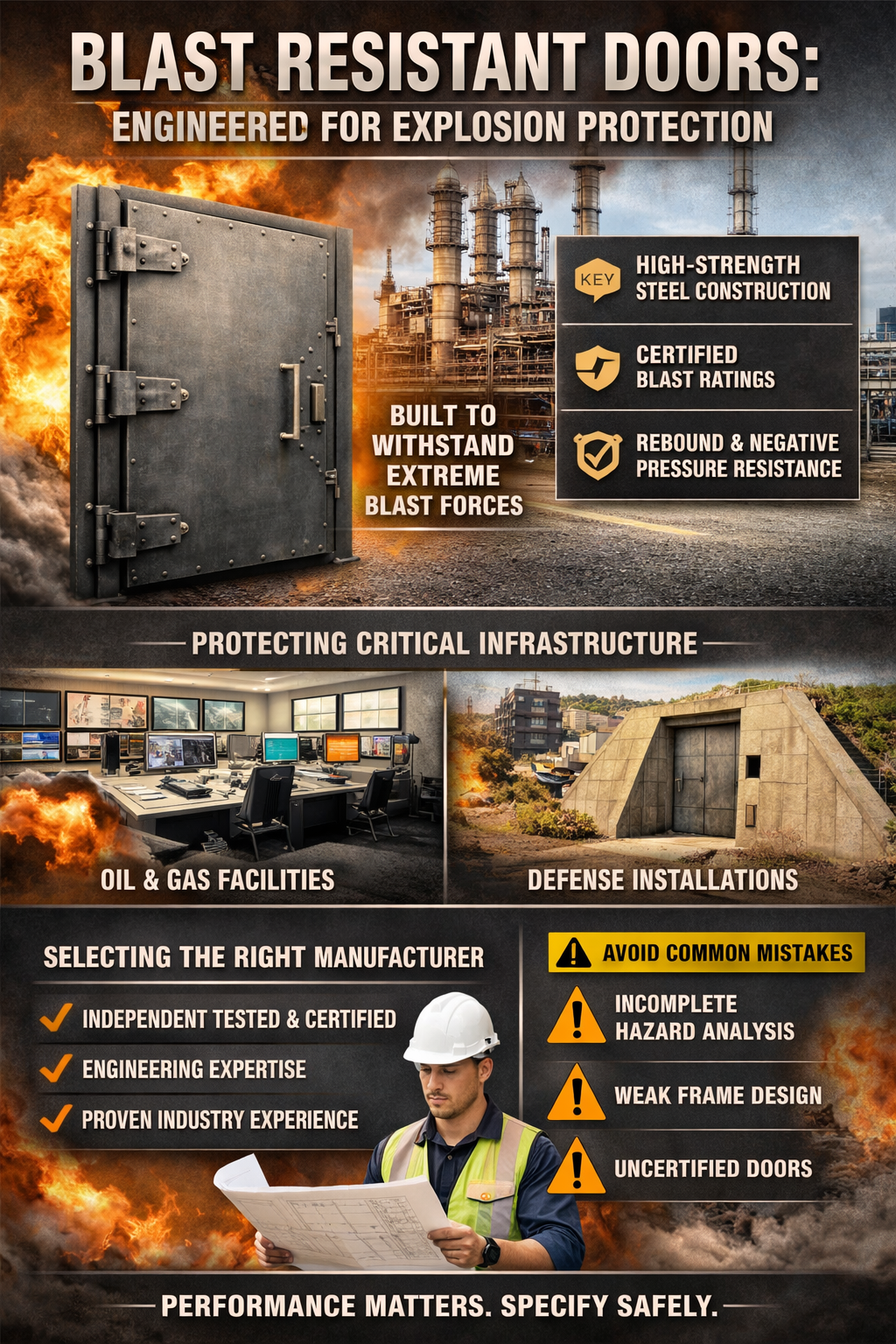
When a gas leak ignited at a petrochemical facility in Texas in 2005, the explosion tore through unprotected sections of the plant within seconds. Areas with blast-rated assemblies held. Areas without them did not. The difference between a contained incident and a catastrophic one came down to engineering decisions made long before that day.
A blast door is one of those decisions. In any facility where explosion risk is real and documented, blast resistant doors are not optional upgrades — they are engineered necessities. Understanding what makes them effective helps safety managers and engineers specify the right solution before an incident, not after.
What a Blast Door Is and Why It Matters
A blast door is a purpose-built, engineered door assembly designed to withstand the dynamic pressure and impulse forces generated by an explosion. It is rated, tested, and certified to perform under specific blast load conditions — not estimated, not assumed.
This sets it apart from every other door type. Fire doors resist heat. Security doors resist forced entry. Neither is built for the sudden, high-velocity pressure wave that an explosion produces. Blast resistant doors are designed for exactly that scenario, and nothing else performs the same function.
In critical facilities, the blast door is the barrier between a hazardous zone and a protected one. Its job is to absorb the energy of an explosion, remain attached to its frame, and keep personnel and equipment on the safe side intact.
How Blast Doors Work
An explosion generates a pressure wave that travels outward at high speed, applying an intense and sudden load to every surface it contacts. A blast door is engineered to accept that load, deform in a controlled and predictable manner, and prevent penetration.
What most people overlook is the rebound phase. After the initial overpressure, a negative pressure wave follows — pulling surfaces outward with significant force. A door that survives the initial blast but detaches during rebound has still failed. Genuine blast resistance requires performance through both phases of the loading cycle.
This is why blast resistant doors are rated by two parameters: peak overpressure (psi or kPa) and impulse (psi-ms). Both values must be derived from a site-specific hazard analysis, not selected from a generic catalogue.
Key Features That Define Performance
High-strength steel construction: Blast doors are fabricated from structural-grade steel plate, with internal stiffeners and reinforcement ribs engineered to distribute and absorb energy efficiently. The steel specification is calculated — not estimated — based on the blast load the door must resist.
Verified pressure and impulse rating: Every legitimate blast door carries a rating backed by independent test data. This rating defines the maximum explosion scenario the door can survive without structural failure. Without a verified rating, there is no assurance of performance.
Engineered frame and anchorage: The frame transfers the full blast load into the surrounding wall or structural slab. A high-performance door panel installed in a poorly designed frame will fail at the connection point. Frame engineering is not a secondary detail — it is as critical as the door leaf itself.
Blast-rated hardware: Hinges, multi-point locking bars, handles, and perimeter seals must all be rated to the same standard as the panel. Standard commercial hardware is not designed for dynamic loading and will fail under blast conditions, compromising the entire assembly.
Rebound and negative pressure resistance: This feature is what separates a properly engineered blast door from a door that is simply heavy. Rebound resistance must be verified through testing, not inferred from material weight or visual appearance.
Where Blast Resistant Doors are Used
The applications span a wide range of critical sectors.
In oil and gas, blast resistant doors protect control rooms, emergency shutdown stations, wellhead enclosures, and personnel shelters. In power generation, they isolate transformer bays, switchgear rooms, and turbine enclosures. Chemical and petrochemical plants rely on them to separate hazardous process zones from occupied operational areas.
Defence installations, LNG terminals, mining operations, and pharmaceutical manufacturing facilities also use blast-rated assemblies as part of their structural hardening and safety zoning strategies.
In every case, the application context defines the hazard scenario, and the hazard scenario defines the specification. Review your facility's safety setup to confirm that existing assemblies are matched to current, documented risk levels.
What Affects Blast Door Price
Blast door price is not a fixed figure — it reflects the technical complexity of the requirement.
Blast rating is the primary driver. Higher overpressure and impulse ratings demand heavier steel, more complex engineering calculations, and more rigorous testing protocols. Door dimensions matter significantly as well. A large vehicle access door requires substantially more material and structural design than a standard personnel door.
Material specification, surface treatment, insulation requirements, and any additional fire rating all affect cost and lead time. Features such as blast-rated vision panels, gas-tight seals, and integrated access control add further to the assembly price. Independently tested and certified doors cost more than uncertified alternatives — but they provide verified performance data that uncertified products simply cannot.
Correct specification from the outset is always more cost-effective than redesign or replacement after a compliance review.
Selecting Blast Proof Door Manufacturers in India
The demand for certified blast proof door manufacturers in India has grown steadily as safety regulations tighten across oil and gas, defence, and power sectors. Manufacturer quality directly determines door performance, and this is not a decision to approach casually.
Start with documentation. Request independent third-party blast test reports verified against recognised standards such as ASTM F2247, ISO 16933, or applicable UFC guidelines. Manufacturers who rely solely on self-certified data cannot provide reliable performance assurance.
Assess engineering capability. A credible manufacturer will support the project with load calculations, site-specific drawings, and installation guidance — not just supply a standard product. Relevant experience across high-risk industries and a clear commitment to after-sales support, including maintenance schedules and spare hardware, should also be confirmed before any procurement decision is made.
Common Mistakes to Avoid
Specifying a blast door without a completed hazard analysis is the most consequential and most common error. No rating is technically justified without a defined pressure and impulse scenario.
Sourcing through general contractors or non-specialist procurement channels frequently results in non-compliant assemblies. These channels lack the technical competence to verify performance or identify specification gaps.
Neglecting frame design is a persistent oversight. Post-blast assessments consistently identify frame detachment as a primary failure mode — yet it continues to be underweighted during the specification process.
Allowing cost pressure to override certified performance is a risk no facility safety manager should accept. Consider upgrading your explosion protection systems based on engineering evidence, not on budget assumptions.
Conclusion
Blast resistant doors protect critical infrastructure by doing what no other door type is engineered to do — withstanding the dynamic, violent forces of an explosion and keeping protected spaces intact. Their effectiveness depends on correct specification, quality manufacturing, independent testing, and proper installation.
For engineers and safety managers, the principle is straightforward: treat blast door selection as an engineering decision, ground it in hazard analysis, and verify every claim a manufacturer makes with documented test data.
Explore more industrial safety insights to stay informed on standards, specifications, and best practices across the sector.
 Turkish
 English
 Arabic
 French
 Spanish
 Portuguese
 Deutsch
 Dutch
Dutch
 Italiano
 Russian
 Romaian
 Portuguese (Brazil)
 Greek
Greek
