


 Pro Benefits
 About
About
 Voorwaarden
 Privacy
 Child Safety & Protection
 Meldingen
 Ayrush Global It Services Pvt Ltd
Geogrid Soil Stabilization for Stronger Infrastructure
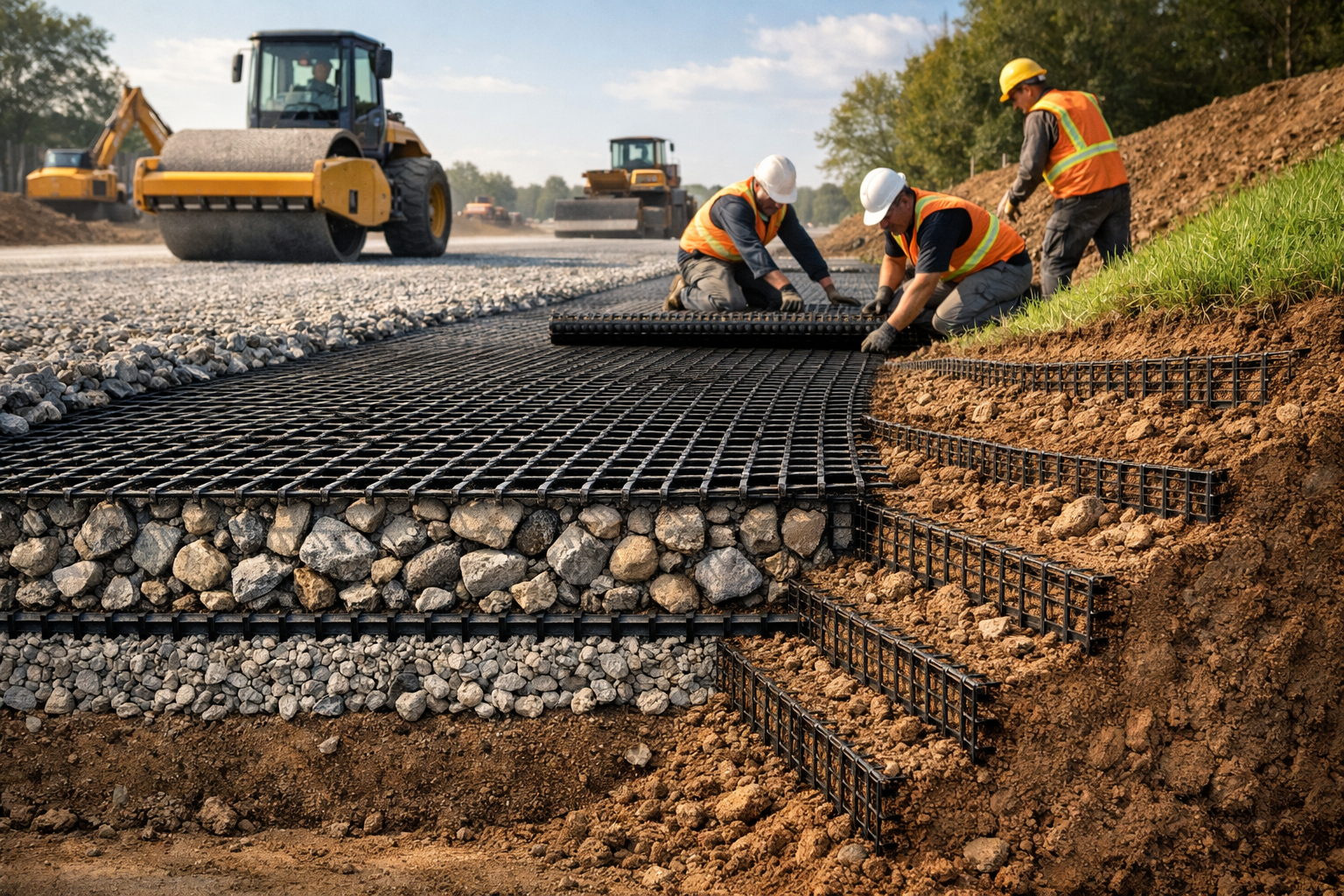
Infrastructure is the backbone of economic growth. From highways that connect cities to railways that transport goods efficiently, every project depends on one critical factor—foundation strength. While materials like asphalt and concrete are visible signs of development, the real performance of any structure begins deep within the ground.
One of the biggest challenges engineers face today is dealing with weak or unstable soil. Not all soil types are capable of supporting heavy loads, especially in areas with high traffic, moisture variations, or soft subgrades. Traditionally, solving this problem required extensive excavation and replacement, which increased both cost and time.
However, the construction industry has evolved. Today, geogrid technology offers a smarter, more efficient solution to soil stabilization. By reinforcing the ground itself, geogrids allow engineers to build stronger structures without excessive resource usage.
The Hidden Challenge Beneath Every Project
Every construction site presents unique soil conditions. Some soils are naturally strong, while others are prone to movement, compression, or erosion.
Weak soil can cause several long-term issues:
- Surface deformation in roads and pavements
- Uneven settlement in structures
- Reduced load-bearing capacity
- Increased maintenance requirements
These problems often appear gradually, making them difficult to detect early. Over time, they can significantly affect the performance and safety of infrastructure.
Instead of replacing soil, modern engineering focuses on improving it—and that’s where geogrids make a real difference.
What Are Geogrids and Why Are They Important?
Geogrids are geosynthetic materials specifically designed to reinforce soil. They consist of a network of interconnected ribs forming a grid-like structure.
This design is not random—it plays a crucial role in how geogrids function.
When soil is placed over the grid:
- Particles enter the openings
- They interlock with the structure
- Movement is restricted
This interaction creates a composite system where soil and geogrid work together to provide enhanced strength.
Geogrids are available in different configurations depending on project needs:
- Uniaxial geogrids for directional strength
- Biaxial geogrids for balanced load distribution
- Triaxial geogrids for complex load conditions
Each type is engineered for specific applications.
How Geogrids Improve Construction Performance
The performance of geogrids is based on a simple but powerful concept—load distribution.
When a load is applied:
- The geogrid spreads the load over a wider area
- It reduces stress on the underlying soil
- It prevents lateral movement
This results in a more stable and durable foundation.
Unlike traditional methods, geogrids do not rely on replacing soil. Instead, they enhance the existing ground, making construction more efficient.
Applications Across Different Sectors
Geogrids are widely used in various construction projects due to their adaptability and effectiveness.
Road Infrastructure
In road construction, geogrids are placed within the base layer. They help distribute traffic loads and prevent deformation.
This leads to:
- Improved road lifespan
- Reduced maintenance
- Better resistance to heavy traffic
Railway Systems
Railway tracks require stable foundations to maintain alignment. Geogrids help reduce settlement and improve performance under dynamic loads.
Retaining Walls and Slopes
Geogrids are essential in reinforced soil structures. They provide stability, allowing for steep slopes and vertical walls.
Embankments
In embankment construction, geogrids improve soil strength and prevent failure.
Industrial Applications
Heavy-load areas such as logistics hubs and industrial yards benefit from geogrid reinforcement, ensuring long-term durability.
Advantages That Make Geogrids Stand Out
Geogrids are becoming a preferred choice because they offer multiple benefits.
Stronger Foundations
They enhance soil strength, allowing it to support heavier loads.
Cost Efficiency
Reduced material requirements and maintenance lead to lower overall costs.
Faster Construction
Easy installation speeds up project timelines.
Durability
Geogrids improve the lifespan of infrastructure by minimizing damage.
Eco-Friendly Solution
They reduce the need for excavation and natural resources, supporting sustainable construction.
A Better Alternative to Traditional Methods
Traditional soil stabilization methods often involve replacing weak soil or adding thick layers of aggregates. These approaches can be resource-intensive and time-consuming.
Geogrids provide a more efficient solution by:
- Reinforcing existing soil
- Reducing material usage
- Minimizing environmental impact
- Delivering consistent performance
This shift reflects the industry’s move toward smarter construction practices.
Role in Sustainable Development
Sustainability is no longer optional in construction—it is essential.
Geogrids contribute to sustainable development by:
- Reducing carbon emissions
- Minimizing resource consumption
- Extending the life of infrastructure
These benefits align with global efforts to create more environmentally responsible construction practices.
Importance of Quality Materials
The effectiveness of geogrids depends on the quality of materials used.
High-quality geogrids ensure:
- Better performance
- Long-term durability
- Resistance to environmental conditions
Choosing the right supplier is critical for achieving these results.
Companies like A&T Engineering Pvt. Ltd. provide geogrid solutions designed for real-world applications, helping engineers achieve reliable and efficient outcomes.
Challenges and Considerations
While geogrids offer many benefits, proper planning is essential.
Key considerations include:
- Soil characteristics
- Load requirements
- Installation techniques
Proper design ensures that the system performs as expected.
Future of Geogrid Technology
The future of construction is moving toward smarter and more efficient solutions.
Geogrid technology is evolving with:
- Advanced materials
- Improved designs
- Greater adaptability
These innovations will expand the use of geogrids in new and challenging applications.
Real-World Impact
Geogrids have already proven their value in numerous projects worldwide. They help create infrastructure that is not only strong but also cost-effective and sustainable.
From highways to industrial zones, their impact is visible in improved performance and reduced maintenance.
Conclusion
The success of any infrastructure project depends on the strength of its foundation. Weak soil can lead to long-term problems, but modern solutions like geogrids offer a smarter way forward.
By reinforcing soil, improving load distribution, and enhancing durability, geogrids have become an essential tool in construction.
As the industry continues to evolve, geogrids will play a key role in building infrastructure that is stronger, more efficient, and more sustainable.
Visit Here for More Information - Geogrid
 Dutch
Dutch
 English
 Arabic
 French
 Spanish
 Portuguese
 Deutsch
 Turkish
 Italiano
 Russian
 Romaian
 Portuguese (Brazil)
 Greek
Greek
