


 Pro Benefits
 About
About
 Terms
Terms
 Privacy
 Child Safety & Protection
 Notifications
 Ayrush Global It Services Pvt Ltd
TDD vs BDD in Complex Systems: Trade-offs and Decisions
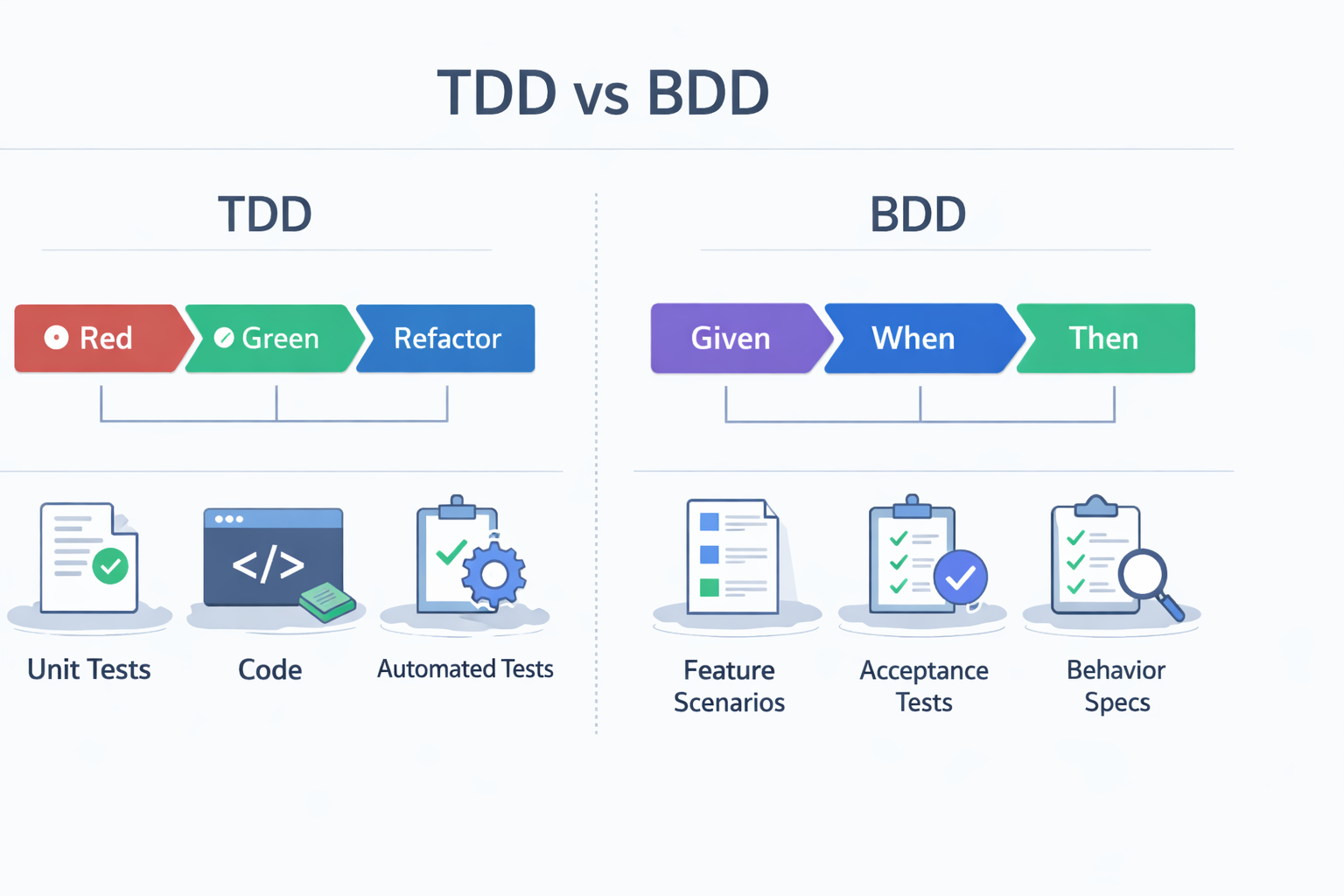
In simple applications, choosing between TDD vs BDD can feel straightforward.
Write tests first or define behavior clearly. Pick an approach and follow it.
But in complex systems, that clarity disappears.
Multiple services interact. Teams scale. Requirements evolve. What works in theory starts to break under real-world constraints.
The question is no longer which approach is better. It becomes a matter of trade-offs, context, and decisions.
Why Complexity Changes the Conversation
In smaller systems, testing strategies are easier to apply consistently.
In complex systems, several factors come into play:
-
Distributed architectures
-
Multiple teams working in parallel
-
Interdependent services
-
Continuous changes in requirements
These factors make it difficult to apply any single approach uniformly.
TDD vs BDD becomes less of a rule and more of a decision-making framework.
Understanding What Each Approach Optimizes For
To make the right decisions, it is important to understand what each approach prioritizes.
TDD focuses on:
-
Code correctness
-
Early validation of logic
-
Safer refactoring
BDD focuses on:
-
Behavior clarity
-
Shared understanding across teams
-
Alignment with user expectations
In complex systems, both of these are necessary, but not always in equal measure.
Where TDD Works Better in Complex Systems
TDD is particularly effective in areas where precision matters.
This includes:
-
Core business logic
-
Data transformations
-
Critical system components
In these areas, small mistakes can have large consequences. TDD helps reduce that risk by ensuring correctness at a granular level.
It also provides a safety net for refactoring, which is common in evolving systems.
Where BDD Adds More Value
BDD becomes more valuable when multiple stakeholders are involved.
This is especially true for:
-
User-facing features
-
Cross-team workflows
-
End-to-end system behavior
In complex environments, misunderstandings are common. BDD helps reduce ambiguity by clearly defining expected behavior.
It ensures that everyone is aligned before development begins.
The Trade-offs Teams Need to Consider
Choosing between TDD vs BDD in complex systems involves trade-offs.
Speed vs Clarity
TDD can be faster for developers working on isolated components.
BDD can slow things down initially due to the need for discussion and definition, but it reduces rework later.
Precision vs Coverage
TDD provides precise validation of logic.
BDD offers broader coverage of system behavior.
Focusing too much on one can leave gaps in the other.
Developer Focus vs Team Alignment
TDD is developer-centric.
BDD is collaboration-centric.
Complex systems require both focused implementation and strong alignment across teams.
Why a Single Approach Rarely Works
In real-world systems, applying only TDD or only BDD is rarely effective.
Strict adherence to one approach often leads to:
-
Gaps in testing coverage
-
Misalignment between teams
-
Increased maintenance overhead
Instead, teams need to adapt their approach based on context.
A Practical Way to Combine TDD and BDD
Many teams find success by using both approaches together.
A practical model looks like this:
-
Use BDD to define what the system should do
-
Use TDD to ensure the implementation works correctly
This creates a layered approach:
-
Behavior is defined at a high level
-
Logic is validated at a detailed level
This combination helps teams manage both complexity and clarity.
Decision-Making in Real Projects
In complex systems, decisions are rarely static.
Teams continuously evaluate:
-
What needs strict validation
-
What requires clear communication
-
Where risks are highest
This leads to a flexible approach where:
-
TDD is applied to critical components
-
BDD is used for defining workflows and behavior
The goal is not to follow a methodology, but to solve problems effectively.
Common Mistakes Teams Make
Even experienced teams can struggle with these approaches.
Some common mistakes include:
-
Applying TDD everywhere, even where it adds little value
-
Using BDD without clear scenarios or purpose
-
Treating both approaches as rigid processes
These mistakes often lead to unnecessary complexity rather than better outcomes.
What Actually Works in Complex Systems
Teams that succeed tend to follow a few practical principles:
-
Apply the right approach based on context
-
Keep testing focused and purposeful
-
Avoid over-engineering processes
-
Continuously adapt based on system needs
These principles help teams navigate the trade-offs effectively.
Final Thoughts
TDD vs BDD in complex systems is not a matter of choosing one over the other.
It is about understanding what each approach offers and when to use it.
Complex systems demand flexibility. They require teams to balance precision with clarity, speed with alignment, and structure with adaptability.
The best approach is not fixed.
It evolves with the system.
 English
 Arabic
 French
 Spanish
 Portuguese
 Deutsch
 Turkish
 Dutch
Dutch
 Italiano
 Russian
 Romaian
 Portuguese (Brazil)
 Greek
Greek
