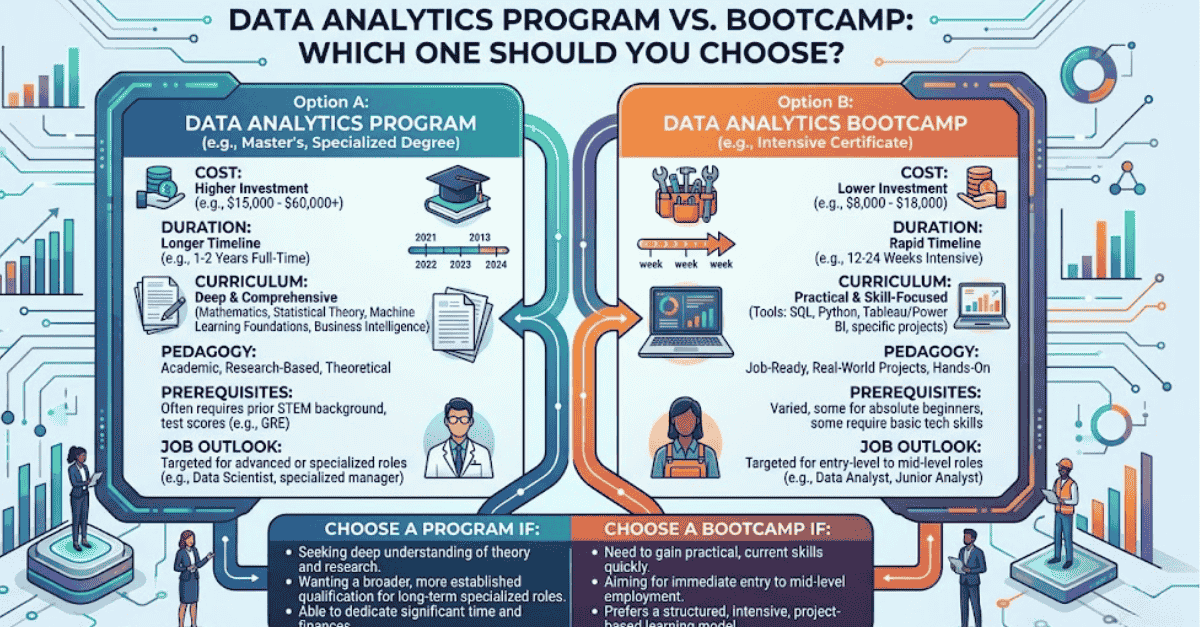
If you’re trying to decide between a data analytics program and a bootcamp, here’s the honest answer: go for a structured program if you want depth and long-term growth, and choose a bootcamp if your goal is to get job-ready as quickly as possible.
That’s the short version. But the real decision? It’s a bit more personal than that.
First, Let’s Clear Up the Confusion
When people search for data analytics courses for beginners, they often assume everything is basically the same—just different price tags and durations.
Not really.
There are two very different learning paths here:
-
Programs (or certification courses) → slower, deeper, more academic
-
Bootcamps → fast, practical, job-focused
I’ve seen people succeed with both… and I’ve also seen people pick the wrong one and regret it halfway through.
What Is a Data Analytics Program?
Think of this as the “steady route.”
A data analytics program usually includes:
These are often offered by universities or platforms like Coursera or edX.
When This Works Best
I usually recommend this path if:
-
You’re completely new (like, zero tech background)
-
You prefer learning why things work, not just how
-
You’re not in a rush to switch careers
A friend of mine took this route and spent almost 8 months learning slowly, building small projects. It wasn’t flashy, but when interviews came, he understood concepts deeply. That helped.
What Is a Data Analytics Bootcamp?
Bootcamps are intense. No sugarcoating that.
They’re designed to take you from beginner (or near-beginner) to job-ready in a short time, usually 8 to 16 weeks.
You’ll get:
And honestly, the pace can feel a bit overwhelming at first.
When This Works Best
Bootcamps are ideal if:
-
You want to switch careers fast
-
You learn better by doing, not reading
-
You can commit serious time daily
I’ve seen people go from zero to job offers in 4–5 months through bootcamps but only because they treated it like a full-time job.
The Biggest Difference (That No One Talks About Enough)
It’s not just about time or cost.
It’s about learning style and pressure tolerance.
Programs = low pressure, steady growth
Bootcamps = high pressure, rapid transformation
I’ve personally tried both styles (not just in analytics, but similar fields), and I’ll say this:
Bootcamps can feel like drinking from a firehose. Programs feel like learning to swim.
Neither is better; it depends on how you handle stress and consistency.
Online Learning: Is It Enough in 2026?
Short answer: yes.
Most data analytics classes online today are actually better than many offline ones from a few years ago.
Why?
-
Live dashboards (Tableau, Power BI) are cloud-based
-
Collaboration tools are remote-first
-
AI-assisted learning (huge trend right now) helps debug faster
In fact, many bootcamps are now fully online and still have strong hiring outcomes.
So don’t worry too much about online vs offline; it’s not the deciding factor anymore.
Real-World Scenario: Two Learners, Two Paths
Let me give you a simple example.
Person A (Program Route)
-
Background: Non-tech graduate
-
Took a 9-month certification program
-
Built 3–4 decent projects
-
Landed a job after ~6 months of applying
Person B (Bootcamp Route)
-
Background: Sales professional
-
Joined a 12-week bootcamp
-
Built a strong portfolio and GitHub
-
Got a job within 2–3 months after finishing
Both succeeded.
The difference? Speed vs. depth.
What Employers Actually Care About
Here’s something that might surprise you:
Most hiring managers don’t really care whether you did a bootcamp or a program.
They look for:
-
Projects (real-world, not toy datasets)
-
Problem-solving ability
-
Communication skills
-
Familiarity with tools (SQL, Python, dashboards)
One hiring lead I spoke to recently said:
“If you can explain your project clearly and show impact, we don’t care how you learned.”
That pretty much sums it up.
Current Trends You Should Know (2025–2026)
This space is evolving fast, so your choice should reflect that.
Some trends I’m seeing:
-
Analytics and AI integration is becoming standard
-
Tools like Python and SQL are still core but storytelling is rising
-
Employers want “decision-makers,” not just data cleaners
So whichever path you choose, make sure it includes:
So… Which One Should You Choose?
If you’re still unsure, here’s a simple way to decide:
Choose a Data Analytics Program if:
-
You want a strong foundation
-
You’re a complete beginner
-
You prefer a slower, less stressful pace
Choose a bootcamp if:
-
You want to switch careers quickly
-
You can handle an intense schedule
-
You’re focused on job placement
Final Thought
People spend a lot of time choosing the “perfect” course.
But the truth is…
The course matters less than what you do with it.
I’ve seen people with top certification courses for data analytics struggle because they didn’t practice enough.
And I’ve seen bootcamp grads with average courses land great roles because they built strong portfolios.
So, pick your path, but more importantly, commit to it.
That’s what really moves the needle.



 Pro Benefits
 О нас
О нас
 Условия использования
 Конфиденциальность
 Child Safety & Protection
 Оповещения
 Ayrush Global It Services Pvt Ltd
 Russian

 English
 Arabic
 French
 Spanish
 Portuguese
 Deutsch
 Turkish
 Dutch
Dutch
 Italiano
 Romaian
 Portuguese (Brazil)
 Greek
Greek