


 Pro Benefits
 О нас
О нас
 Условия использования
 Конфиденциальность
 Child Safety & Protection
 Оповещения
 Ayrush Global It Services Pvt Ltd
Which Job Roles Need TOSCA Skills Today
TOSCA, developed by Tricentis, is a widely adopted automation testing tool used for functional and regression testing across enterprise applications. Professionals with TOSCA skills are capable of designing, executing, and maintaining automated test scripts efficiently, improving software quality, and supporting continuous integration/continuous delivery (CI/CD) pipelines. Job roles requiring TOSCA expertise include test automation engineers, QA analysts, software testers, and DevOps professionals, particularly in organizations adopting agile and DevOps practices. Learning TOSCA through structured courses like Tricentis TOSCA Online Training prepares professionals for certification and real-world project implementation.
What is TOSCA?
TOSCA (Tricentis Test Automation) is a model-based test automation tool designed to simplify testing for complex enterprise applications. Unlike traditional script-based automation, TOSCA allows testers to create reusable test components, reducing maintenance overhead and improving test coverage. Key features include:
-
Model-Based Test Automation (MBTA): Reusable test modules mapped to business processes.
-
Cross-Technology Testing: Supports web, desktop, mobile, API, and mainframe testing.
-
Integration with CI/CD Pipelines: Works with tools like Jenkins, Azure DevOps, and Git for automated testing.
-
Reporting and Analytics: Provides test execution metrics and defect tracking integration with tools like Jira.
Professionals with TOSCA skills can automate repetitive test scenarios, reduce manual effort, and contribute to faster software delivery cycles.
How Does TOSCA Work in Real-World IT Projects?
TOSCA operates through a structured workflow, making it suitable for enterprise IT projects. Its model-based approach allows teams to:
-
Analyze Requirements: Testers review functional specifications and define test scenarios.
-
Create Test Cases: Using TOSCA’s Modules and TestCases feature, testers build reusable components representing application workflows.
-
Execute Tests: TOSCA can run tests across multiple environments and platforms, including web browsers, mobile devices, and APIs.
-
Report Defects: Integration with defect-tracking systems like Jira or ServiceNow ensures that issues are logged and tracked efficiently.
-
Maintain Test Suites: Updates to applications require minimal changes due to TOSCA’s modular structure.
This workflow is widely adopted in industries such as banking, healthcare, insurance, and retail, where application complexity demands robust test automation.
Why is TOSCA Important for Working Professionals?
TOSCA skills are highly relevant because they align with modern software development practices:
-
Reduced Manual Effort: Automation of repetitive tests accelerates delivery.
-
Support for Agile and DevOps: Enables continuous testing within CI/CD pipelines.
-
Cross-Functional Expertise: Professionals gain experience in API testing, GUI testing, and end-to-end automation.
-
Certification Advantage: Completing TOSCA Automation Certification signals proficiency to employers.
-
Career Growth: Positions professionals as test automation experts, increasing employability in global IT markets.
Enterprises increasingly prefer TOSCA due to its modularity, scalability, and adaptability to diverse application architectures.
What Skills Are Required to Learn Tricentis TOSCA Online Training?
To effectively learn TOSCA through online training, professionals should have a foundational understanding of:
-
Software Testing Concepts: Manual testing, test case design, defect lifecycle.
-
Basic Programming Knowledge: Especially scripting languages like VBScript or JavaScript for advanced TOSCA automation.
-
Database Understanding: SQL for validating test data.
-
CI/CD Tools: Jenkins, Git, and Azure DevOps integration basics.
-
API and Web Services: Understanding REST and SOAP services for end-to-end automation scenarios.
-
Analytical Skills: Ability to analyze application workflows and model test cases accurately.
Tricentis TOSCA Online Training programs typically cover these foundational skills, followed by advanced topics such as test data management, execution lists, and integration with third-party tools.
How is TOSCA Used in Enterprise Environments?
In enterprise settings, TOSCA is used to streamline testing processes and ensure high-quality releases. Common applications include:
-
Regression Testing: Automating recurring functional tests to ensure updates do not break existing features.
-
End-to-End Testing: Validating complex workflows across multiple systems, e.g., ERP, CRM, and web applications.
-
API Testing: Automating verification of backend services without manual intervention.
-
CI/CD Integration: Triggering automated tests in build pipelines for continuous validation.
-
Compliance Testing: Ensuring software meets regulatory standards in industries like banking and healthcare.
Table 1: TOSCA Usage Across Enterprise Workflows
|
Workflow Area |
TOSCA Application |
Benefits |
|
Web Application Testing |
Automate user scenarios across browsers |
Reduced manual regression effort |
|
API Testing |
Validate REST/SOAP endpoints |
Faster backend validation |
|
ERP Systems |
Automate SAP, Oracle workflows |
Ensure enterprise-level process accuracy |
|
CI/CD Pipelines |
Trigger tests via Jenkins, Azure DevOps |
Supports agile and DevOps practices |
|
Test Reporting |
Integrated dashboards and analytics |
Provides actionable metrics to stakeholders |
What Job Roles Use TOSCA Daily?
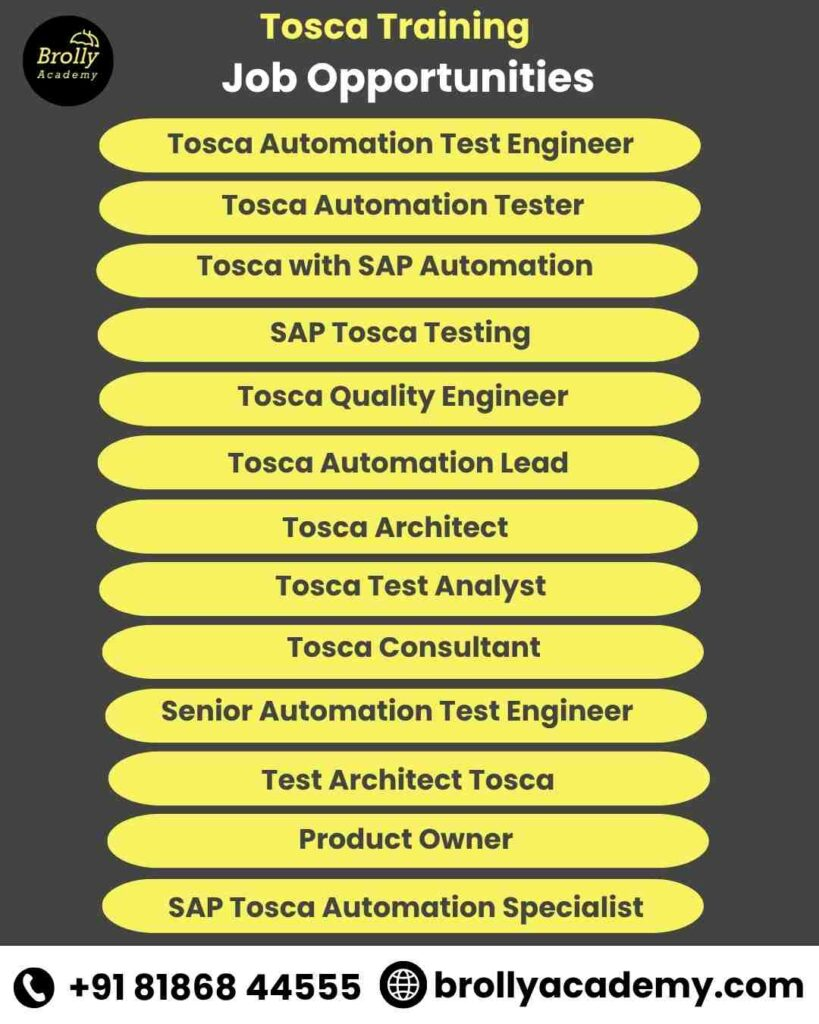
TOSCA skills are relevant to multiple IT roles, primarily in software quality assurance and test automation. The following job roles frequently require TOSCA expertise:
1. Test Automation Engineer
-
Designs, develops, and executes automated test scripts.
-
Implements reusable modules using TOSCA’s model-based approach.
-
Integrates automated tests into CI/CD pipelines for continuous delivery.
2. QA Analyst / Software Tester
-
Performs functional and regression testing.
-
Leverages TOSCA to reduce manual testing effort.
-
Reports defects and ensures application compliance with quality standards.
3. DevOps Engineer
-
Ensures automated tests are part of deployment pipelines.
-
Monitors build and test results, coordinating with QA teams for quick fixes.
4. Business Analyst (with Automation Exposure)
-
Uses TOSCA to validate business workflows.
-
Collaborates with developers and testers to map requirements to test scenarios.
5. TOSCA Specialist / Consultant
-
Provides guidance for implementing TOSCA in enterprise projects.
-
Designs reusable modules and frameworks for multiple teams.
Table 2: Job Role vs Required TOSCA Skills
|
Job Role |
Key TOSCA Skills |
Typical Responsibilities |
|
Test Automation Engineer |
Test case design, execution, CI/CD integration |
Automate end-to-end tests |
|
QA Analyst / Software Tester |
Regression testing, defect reporting, module creation |
Ensure software meets functional requirements |
|
DevOps Engineer |
Pipeline integration, execution monitoring |
Embed automated testing in release cycles |
|
Business Analyst |
Test scenario modeling, workflow validation |
Validate business requirements |
|
TOSCA Consultant |
Framework design, reusable module creation |
Implement TOSCA across projects and teams |
What Careers Are Possible After Learning TOSCA Automation?
TOSCA training opens pathways to several high-demand careers in IT, including:
-
Senior Test Automation Engineer: Leads automation initiatives, mentors junior testers, and ensures comprehensive test coverage.
-
Automation Architect: Designs enterprise-wide automation frameworks, optimizing test efficiency and reusability.
-
Quality Assurance Manager: Oversees QA processes and ensures teams adhere to testing best practices.
-
DevOps/TestOps Specialist: Integrates automated tests into CI/CD pipelines to accelerate deployment cycles.
-
TOSCA Consultant: Provides consulting for implementing TOSCA in enterprise environments, focusing on scalability and maintainability.
These roles are widely available in sectors like finance, healthcare, telecommunications, and retail, where large-scale application automation is critical.
FAQ / Q&A Section
Q1: What is the difference between TOSCA Automation and traditional automation tools?
A: TOSCA uses a model-based approach rather than script-based coding. It allows creating reusable modules that simplify maintenance, reduce redundancy, and support multiple technologies and platforms, unlike traditional tools like Selenium, which are code-intensive.
Q2: Do I need programming experience for Tricentis TOSCA Online Training?
A: Basic programming knowledge helps, especially for advanced scenarios, but TOSCA’s model-based framework allows non-programmers to build and execute tests effectively.
Q3: How does TOSCA Automation Certification help in career growth?
A: Certification validates a professional’s ability to design, execute, and maintain automated tests using TOSCA, making them more competitive for test automation and QA roles in enterprise environments.
Q4: Can TOSCA be used for API testing?
A: Yes, TOSCA supports both REST and SOAP API testing, enabling automated validation of backend services and integrations within complex workflows.
Q5: Which industries widely adopt TOSCA?
A: Banking, insurance, healthcare, retail, and IT services commonly use TOSCA for large-scale test automation, regression testing, and integration testing in enterprise applications.
Key Takeaways
-
TOSCA skills are essential for automation engineers, QA analysts, DevOps professionals, and consultants.
-
Model-based testing reduces maintenance, supports cross-technology testing, and integrates with CI/CD pipelines.
-
Tricentis TOSCA Online Training prepares professionals for real-world testing scenarios and certification.
-
TOSCA Automation Certification validates expertise and improves career opportunities in enterprise IT environments.
-
Hands-on application in web, API, ERP, and CI/CD workflows is critical for practical proficiency.
For professionals aiming to strengthen their automation expertise, exploring H2K Infosys TOSCA courses offers structured, hands-on learning aligned with industry requirements.
 Russian
 English
 Arabic
 French
 Spanish
 Portuguese
 Deutsch
 Turkish
 Dutch
Dutch
 Italiano
 Romaian
 Portuguese (Brazil)
 Greek
Greek
