


 Pro Benefits
 Σχετικά
 Όρους
Όρους
 Ιδιωτικότητα
 Child Safety & Protection
 Ειδοποιήσεις
 Ayrush Global It Services Pvt Ltd
How to Choose the Right Test Automation Framework for Your Project?
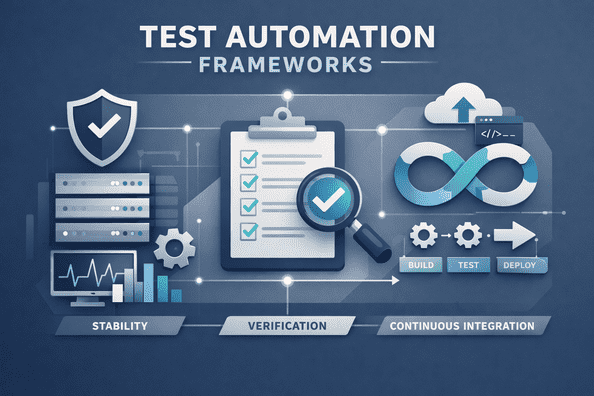
Automation has become an essential part of modern software development. As applications grow in complexity and release cycles become faster, teams rely on automated testing to maintain software quality. However, the effectiveness of automation largely depends on selecting the right framework. With many available options, choosing suitable test automation frameworks for a project requires careful consideration of several technical and organizational factors.
Selecting an appropriate framework helps teams create reliable tests, reduce maintenance efforts, and improve testing efficiency throughout the development lifecycle.
Understand the Project Requirements
The first step in selecting the right framework is understanding the specific requirements of the project. Different applications have different testing needs depending on their architecture, technology stack, and complexity.
For example, a web-based application may require frameworks that support browser automation, while mobile applications need frameworks designed for mobile environments. Projects involving APIs or microservices may require frameworks that can easily handle service-level testing.
Evaluating project requirements ensures that teams select test automation frameworks capable of supporting the application’s testing goals.
Consider the Technology Stack
The technology stack used in a project plays a significant role in framework selection. Compatibility between the testing framework and the development technologies is essential for seamless integration.
For instance, if a project uses JavaScript-based development frameworks, it may be beneficial to choose automation tools that work well with JavaScript testing libraries. Similarly, applications developed using Java or Python may benefit from frameworks that support those programming languages.
Ensuring alignment between the technology stack and testing framework reduces implementation challenges and simplifies maintenance.
Evaluate Framework Types
There are several types of automation frameworks designed to support different testing strategies. Understanding these categories helps teams determine which structure best suits their testing needs.
A modular framework organizes tests into independent modules, making them easier to maintain. Data-driven frameworks separate test data from test scripts, allowing testers to run the same tests with multiple input values. Keyword-driven frameworks allow testers to define testing actions using keywords, which can simplify test creation.
Hybrid frameworks combine elements from multiple approaches, offering greater flexibility and scalability. Choosing the appropriate type ensures that test automation frameworks align with the testing goals of the organization.
Assess Scalability and Maintainability
As software systems grow, testing frameworks must be able to scale alongside the application. A framework that works well for small projects may become difficult to manage as the number of test cases increases.
When evaluating frameworks, teams should consider how easily the framework can support additional tests, integrate with new tools, and adapt to changes in application architecture.
Maintainability is equally important. Test scripts should be easy to update when application features change. Frameworks that support reusable components and modular design typically provide better long-term maintainability.
Integration with Development Pipelines
Modern development teams often use continuous integration and continuous delivery pipelines to automate software builds and deployments. The chosen testing framework should integrate smoothly with these pipelines.
Integration allows automated tests to run whenever new code changes are introduced. This ensures that defects are detected early in the development process and reduces the risk of issues reaching production.
Frameworks that support CI/CD environments help teams maintain consistent testing across development cycles.
Evaluate Team Skills and Learning Curve
Another important factor when selecting test automation frameworks is the skill set of the team. Some frameworks require advanced programming knowledge, while others are designed to be more accessible for testers with limited coding experience.
Choosing a framework that aligns with the team’s expertise helps reduce the learning curve and improves productivity. If the framework is too complex, teams may struggle to maintain tests or fully utilize its capabilities.
Providing training and documentation can also help teams adopt new frameworks more effectively.
Focus on Reliability and Reporting
A good automation framework should provide reliable test execution and detailed reporting capabilities. Reliable frameworks ensure that test results are consistent and minimize false failures.
Reporting features help teams understand test outcomes, identify defects quickly, and track testing progress over time. Clear reporting also improves communication between developers, testers, and project stakeholders.
Reliable frameworks with strong reporting capabilities improve overall testing transparency.
Follow Proven Testing Practices
Selecting the right framework is only part of building a successful automation strategy. Teams should also follow established testing guidelines to ensure long-term success.
Implementing structured test design, maintaining reusable test scripts, and organizing test cases properly are essential elements of effective automation. Many of these principles align with widely accepted test automation best practices, which emphasize maintainability, scalability, and efficient test management.
Following these practices helps teams maximize the value of their automation frameworks.
Conclusion
Choosing the right test automation frameworks is a critical decision that directly affects the success of automation efforts. By evaluating project requirements, technology compatibility, scalability, and team expertise, organizations can identify frameworks that best support their testing goals.
When combined with strong testing practices and integration into modern development pipelines, the right framework enables teams to build reliable automated tests, detect defects earlier, and maintain high software quality throughout the development lifecycle.
 Greek
Greek
 English
 Arabic
 French
 Spanish
 Portuguese
 Deutsch
 Turkish
 Dutch
Dutch
 Italiano
 Russian
 Romaian
 Portuguese (Brazil)
