Substance abuse insurance billing is one of the most complex and sensitive areas in healthcare revenue management. Providers treating substance use disorders must balance patient care, strict payer regulations, evolving coding rules, and documentation requirements. Even small billing errors can result in denials, delayed payments, audits, or compliance risks.
This comprehensive guide explains how substance abuse insurance billing works in the United States, the common challenges providers face, and how specialized mental health billing services can improve accuracy, compliance, and reimbursement.
Introduction: Why Substance Abuse Insurance Billing Matters
Substance use disorder treatment is medically necessary care. Yet billing for these services is often more complicated than traditional medical billing because:
-
Payers apply strict medical necessity criteria
-
Authorization requirements frequently change
-
Documentation must support intensity of care
-
Coding varies by service setting and provider type
-
Medicare and Medicaid rules differ from commercial insurers
Accurate substance abuse insurance billing ensures providers are paid properly while maintaining compliance with federal and state regulations.
Understanding Substance Abuse Insurance Billing
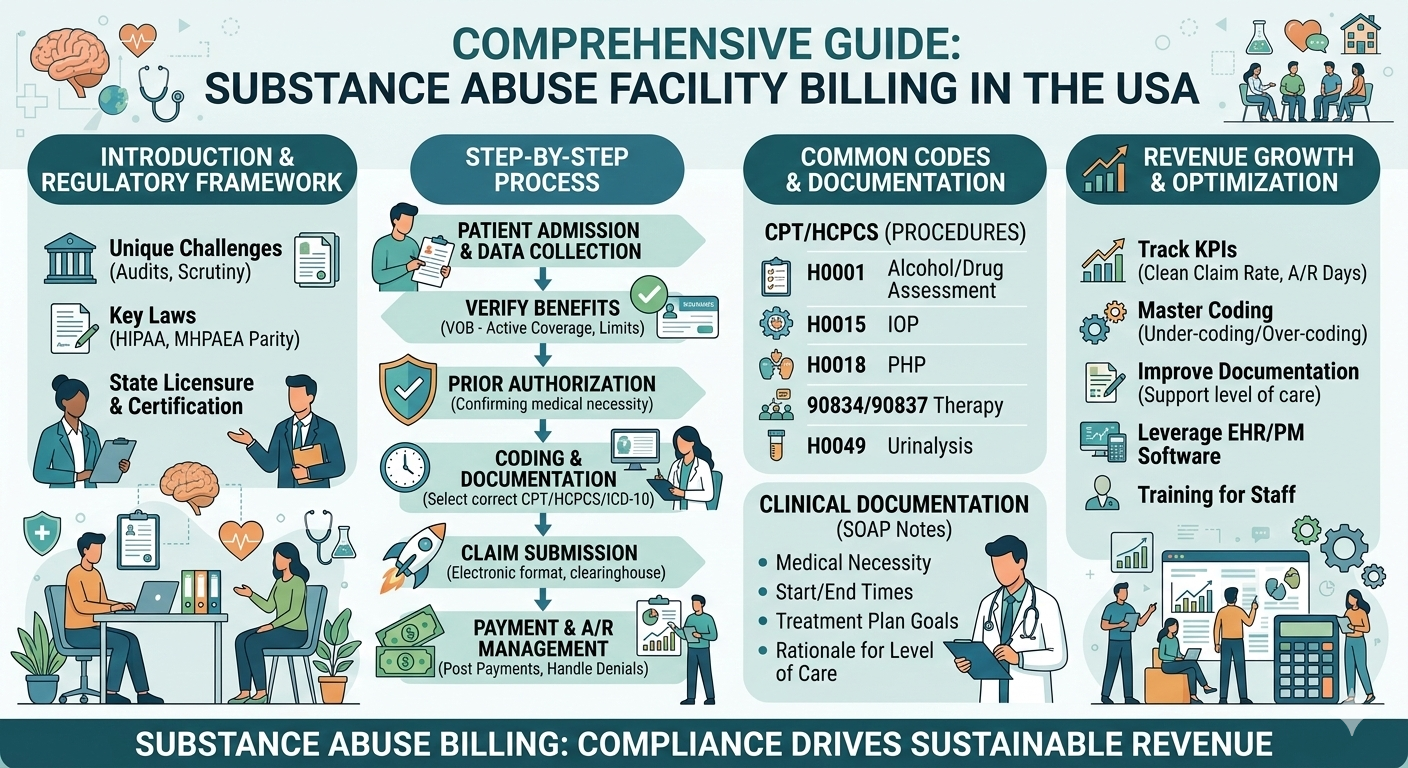
Substance abuse insurance billing refers to submitting claims to insurance companies for services related to substance use disorder treatment. These services may include:
-
Outpatient therapy
-
Intensive outpatient programs (IOP)
-
Partial hospitalization programs (PHP)
-
Residential treatment
-
Medication-assisted treatment (MAT)
-
Group therapy sessions
-
Psychiatric evaluations
Because addiction treatment often overlaps with psychiatric care, providers frequently rely on behavioral and mental health billing services to manage the complexities of coding and reimbursement.
Substance abuse billing requires accurate use of CPT codes, HCPCS codes, ICD-10 diagnosis codes, and place-of-service indicators. In addition, payers closely review documentation to confirm that the level of care meets established clinical guidelines.
Key Components of Billing for Mental Health and Substance Abuse Services
1. Accurate Coding and Documentation
Coding and billing for mental health services must align with documentation in the patient record. This includes:
-
Detailed intake assessments
-
Treatment plans with measurable goals
-
Progress notes
-
Time-based documentation for therapy sessions
-
Physician supervision notes when required
Improper coding is a leading cause of claim denials in medical billing for mental health. That is why many providers turn to mental health billing specialist companies to reduce risk.
2. Prior Authorization and Verification
Insurance carriers often require prior authorization for substance abuse treatment programs. Before services begin, billing teams must verify:
Failing to obtain proper authorization can lead to non-payment, even if the treatment was medically necessary.
3. Billing Medicare for Mental Health Services
Billing Medicare for mental health services has its own guidelines. Medicare Part B covers outpatient therapy, psychiatric evaluations, and certain substance use treatments. However:
-
Documentation must clearly support medical necessity
-
Time requirements must be accurate
-
Certain services require supervision
Providers who treat older adults with substance use disorders must stay compliant with Medicare’s evolving behavioral health policies.
Common Challenges in Substance Abuse Insurance Billing
Substance abuse insurance billing is prone to errors because of multiple moving parts. Some frequent challenges include:
-
Frequent policy updates from payers
-
Confusion between psychiatric and addiction codes
-
Incorrect modifiers for group or family therapy
-
Denials related to level-of-care criteria
-
Underpayments due to misapplied fee schedules
Even experienced in-house teams can struggle. This is why outsourcing mental health billing and coding has become increasingly popular among behavioral health clinics.
Why Many Providers Choose Outsourced Billing for Mental Health
Outsourced billing for mental health allows providers to focus on patient care while specialists handle revenue cycle management.
A mental health billing company typically offers:
When providers work with a top mental health billing company, they often see improved clean claim rates and faster reimbursements.
Outsourcing mental health billing also reduces staffing costs, training expenses, and compliance risks. Instead of building an internal team, clinics can partner with billing companies for mental health that already understand payer-specific guidelines.
How Mental Health Billing Services Improve Revenue
A reliable mental health billing services company focuses on more than just submitting claims. Their approach usually includes:
Denial Prevention Strategy
By analyzing payer trends, billing services for mental health clinics identify patterns in denials and implement corrective actions before problems escalate.
Specialized Knowledge in Behavioral Health
Behavioral and mental health billing services require familiarity with therapy codes, substance use disorder treatment regulations, and credentialing standards.
Credentialing and Network Enrollment
Mental health billing and credentialing services ensure providers are properly enrolled with insurance networks. Credentialing errors can delay payments for months, which directly affects cash flow.
Optimized Coding Practices
Mental health billing solutions emphasize correct code usage and modifier application to reduce audits and maximize reimbursement.
Substance Abuse Insurance Billing in Different Care Settings
Substance abuse treatment occurs in various settings, and billing requirements differ for each.
Outpatient Clinics
Billing for mental health providers in outpatient settings typically involves individual therapy codes, medication management visits, and group sessions.
Intensive Outpatient Programs
IOP billing must clearly document hours of service per week and therapeutic components. Payers often scrutinize these claims.
Residential Treatment Centers
Residential billing requires detailed documentation of daily services and supervision. Insurance carriers review these claims carefully to determine medical necessity.
Private Practice Therapists
Billing for mental health therapists in private practice can seem straightforward, but compliance and documentation errors still occur. Partnering with mental health medical billing experts reduces risk.
How to Choose the Right Mental Health Billing Company
Selecting the best mental health billing company is critical for long-term financial stability. Consider the following:
-
Experience in substance abuse insurance billing
-
Dedicated behavioral health billing teams
-
Transparent reporting and analytics
-
HIPAA-compliant systems
-
Strong denial management process
While some providers look for a cheap outsource mental health billing company to reduce costs, it is important to balance affordability with expertise and compliance standards.
The best outsource mental health billing and coding services focus on long-term revenue growth rather than short-term cost savings.
Compliance Considerations in Substance Abuse Billing
Substance abuse treatment providers must follow:
Mental health billing requires careful handling of sensitive patient data, especially in addiction treatment where confidentiality rules may be stricter.
Working with a mental health billing services company experienced in compliance helps prevent audits and legal complications.
The Role of Technology in Mental Health Billing
Modern billing services for mental health integrate electronic health records with billing software to:
-
Automate claim generation
-
Flag missing documentation
-
Track authorization deadlines
-
Monitor reimbursement trends
Data-driven reporting allows providers to see which services generate the highest revenue and which payers cause the most denials.
How 247 Medical Billing Services Supports Behavioral Health Providers
Healthcare organizations treating substance use disorders require more than basic claim submission. They need end-to-end revenue cycle management tailored to behavioral health.
247 Medical Billing Services provides comprehensive medical billing services, medical coding services, and medical billing and coding services designed specifically for substance abuse and mental health providers. Their revenue cycle management strategies improve claim accuracy, reduce denials, and accelerate payments. In addition, their credentialing services help providers enroll with insurance networks efficiently, ensuring uninterrupted reimbursement.
By combining expertise in medical billing for mental health with strong compliance protocols, providers can stabilize cash flow while focusing on patient recovery outcomes.
Conclusion
Substance abuse insurance billing in the USA demands accuracy, compliance, and specialized knowledge. From prior authorization to appeals management, every step impacts revenue and sustainability.
Providers who invest in professional mental health billing services, whether in-house or outsourced, position their practice for financial stability and long-term growth. With proper systems and expert support, substance abuse treatment centers can reduce denials, improve reimbursement, and focus on delivering life-changing care.
Frequently Asked Questions
What is substance abuse insurance billing?
Substance abuse insurance billing is the process of submitting claims to insurance companies for addiction treatment and related behavioral health services, ensuring compliance with payer guidelines.
Why is billing for mental health services more complex than general medical billing?
Billing for mental health services involves strict documentation requirements, time-based coding, authorization rules, and medical necessity reviews that differ from standard medical claims.
Is outsourcing mental health billing a good option for small clinics?
Yes, outsourcing mental health billing can help small clinics reduce administrative burden, improve claim accuracy, and increase reimbursement rates without hiring full-time billing staff.
Does Medicare cover substance abuse treatment?
Yes, Medicare covers certain outpatient and inpatient substance use disorder treatments. Billing Medicare for mental health services requires strict adherence to documentation and coding guidelines.
How can a mental health billing company reduce claim denials?
A specialized mental health billing company monitors payer rules, verifies insurance eligibility, ensures correct coding, manages authorizations, and handles appeals to minimize denials.
What should I look for in the best mental health billing services company?
Look for experience in behavioral health billing, transparent reporting, compliance expertise, strong denial management, and proven results in improving revenue cycle performance.



 Pro Benefits
 About
About
 Termeni
 Confidențialitate
 Child Safety & Protection
 Notificări
 Ayrush Global It Services Pvt Ltd
 Romaian

 English
 Arabic
 French
 Spanish
 Portuguese
 Deutsch
 Turkish
 Dutch
Dutch
 Italiano
 Russian
 Portuguese (Brazil)
 Greek
Greek