When utilities and EPC contractors plan new overhead transmission or line-upgrade projects, selecting the right conductor directly affects system reliability, line losses, tower design, and long-term operating cost. ACSR conductor (Aluminum Conductor Steel Reinforced) remains one of the most trusted choices for medium- to extra-high-voltage networks because it balances mechanical strength with excellent electrical performance.
This guide explains how ACSR conductors work, where they perform best, and how HNBF Power supports utilities and infrastructure developers with reliable, project-ready ACSR solutions.
What Is an ACSR Conductor?
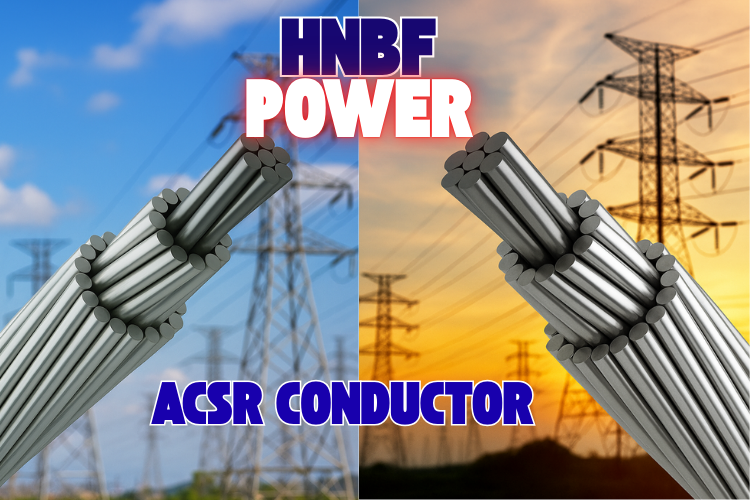
An ACSR conductor is a stranded overhead line conductor made of:
This hybrid construction allows ACSR to achieve a much higher strength-to-weight ratio compared with all-aluminum conductors, making it ideal for long spans, river crossings, and heavy mechanical loading conditions.
From a grid engineering perspective, ACSR offers a proven balance between:
-
electrical conductivity
-
mechanical reliability
-
installation flexibility
-
long service life
Why ACSR Conductor Is Widely Used in Transmission Lines
1. High mechanical strength for long spans
The steel-reinforced core significantly increases breaking load. This allows designers to use longer span lengths and reduce the number of support structures an important benefit for utility transmission corridors and rural distribution extensions.
2. Stable performance under environmental stress
ACSR conductors are designed to withstand:
-
strong wind loads
-
ice accumulation
-
high mechanical tension
-
temperature variations
This makes them suitable for demanding climates and difficult terrains.
3. Proven compatibility with existing infrastructure
Many transmission and distribution networks worldwide are already designed around ACSR conductor characteristics. For utilities upgrading or reconductoring existing lines, ACSR provides excellent mechanical and structural compatibility.
ACSR Conductor Manufacturing Process (Engineering Overview)
Understanding the ACSR conductor manufacturing process is essential for engineers and procurement teams evaluating supplier quality.
Steel core production
The process starts with galvanized steel wires that are stranded together to form the core. The steel is treated for corrosion resistance and mechanical stability.
Aluminum wire drawing and stranding
High-purity aluminum rods are drawn into wires and stranded concentrically around the steel core. The number of layers and strand configuration depend on the required conductor size and tensile rating.
Final stranding and quality inspection
During final stranding, strict control of lay length, strand tension, and concentric alignment is maintained to ensure:
-
uniform mechanical loading
-
consistent electrical contact
-
long-term vibration resistance
At HNBF Power, every ACSR conductor is manufactured under controlled production lines and verified for mechanical and electrical conformity before dispatch.
Key Technical Characteristics of ACSR Conductor
Electrical performance
The aluminum layers carry the electrical current. While the steel core contributes minimal conductivity, it enables higher mechanical loading without increasing conductor diameter.
Mechanical performance
ACSR conductors offer:
-
high ultimate tensile strength (UTS)
-
controlled elastic elongation
-
excellent resistance to creep over long service periods
Thermal behavior
Standard ACSR conductors are designed for conventional operating temperatures. For utilities requiring higher thermal ratings, design variants can be optimized based on project load profiles.
Typical Applications of ACSR Conductor
ACSR conductor is widely used in:
-
overhead transmission lines
-
primary and secondary distribution lines
-
river and highway crossings
-
long-span corridor projects
-
rural electrification and grid expansion programs
For power utilities and EPC contractors, ACSR remains a practical and cost-efficient solution where both strength and electrical performance are critical.
How HNBF Power Supports Utility and EPC Projects
As a global manufacturer of overhead conductors and power cables, HNBF Power supplies ACSR conductors designed specifically for utility-scale and infrastructure projects.
Engineers and procurement managers benefit from:
-
customized conductor constructions (stranding, steel core type, diameter)
-
project-specific tensile and sag performance optimization
-
stable batch consistency for large-volume deliveries
-
compliance with international utility and grid standards
Beyond ACSR, HNBF Power also manufactures AAC, AAAC, ABC cables, LV power cables, and concentric cables allowing utilities to source complete overhead and distribution solutions from a single qualified supplier.
ACSR vs AAC and AAAC – Engineering Selection Perspective
ACSR vs AAC
AAC conductors offer higher conductivity but lower mechanical strength. For short spans and urban distribution networks, AAC may be suitable. However, for long spans and high mechanical loading, ACSR provides a safer design margin.
ACSR vs AAAC
AAAC conductors deliver better corrosion resistance and slightly lower weight. In coastal or highly corrosive environments, AAAC can be advantageous. Yet for projects where mechanical strength and span length dominate design requirements, ACSR remains the preferred choice.
FAQs About ACSR Conductor
1. What is the main advantage of ACSR conductor in transmission projects?
The primary advantage is its high tensile strength provided by the steel core, allowing longer spans and improved mechanical safety without significantly increasing conductor size.
2. Is ACSR conductor suitable for high-voltage transmission lines?
Yes. ACSR conductor is widely used in medium-, high-, and extra-high-voltage overhead transmission systems worldwide.
3. How does the steel core affect electrical performance?
The steel core mainly provides mechanical support. The aluminum layers carry the current, so electrical performance remains highly efficient for standard grid applications.
4. Can ACSR conductor be customized for specific projects?
Yes. Strand configuration, steel core type, conductor diameter, and tensile ratings can all be tailored to meet project-specific mechanical and electrical requirements.
5. How long is the typical service life of an ACSR conductor?
With proper installation and environmental protection, ACSR conductors can operate reliably for several decades in utility transmission networks.
Final Thoughts
For modern transmission and distribution infrastructure, the ACSR conductor continues to be a dependable and technically sound solution. Its combination of mechanical strength, electrical efficiency, and installation flexibility makes it especially suitable for long-span and heavy-duty overhead line projects.
If your utility or EPC project requires reliable, customized ACSR conductor solutions, contact HNBF Power today to discuss your technical requirements and receive a project-specific conductor proposal tailored to your grid and performance needs.



 Pro Benefits
 Sobre
Sobre
 Termos
 Privacidade
 Child Safety & Protection
 Notificações
 Ayrush Global It Services Pvt Ltd
 Portuguese

 English
 Arabic
 French
 Spanish
 Deutsch
 Turkish
 Dutch
Dutch
 Italiano
 Russian
 Romaian
 Portuguese (Brazil)
 Greek
Greek