


 Pro Benefits
 About
About
 Koşullar
 Gizlilik
 Child Safety & Protection
 Bildirimler
 Ayrush Global It Services Pvt Ltd
Product Scope Definition and Validation Metrics for MVP
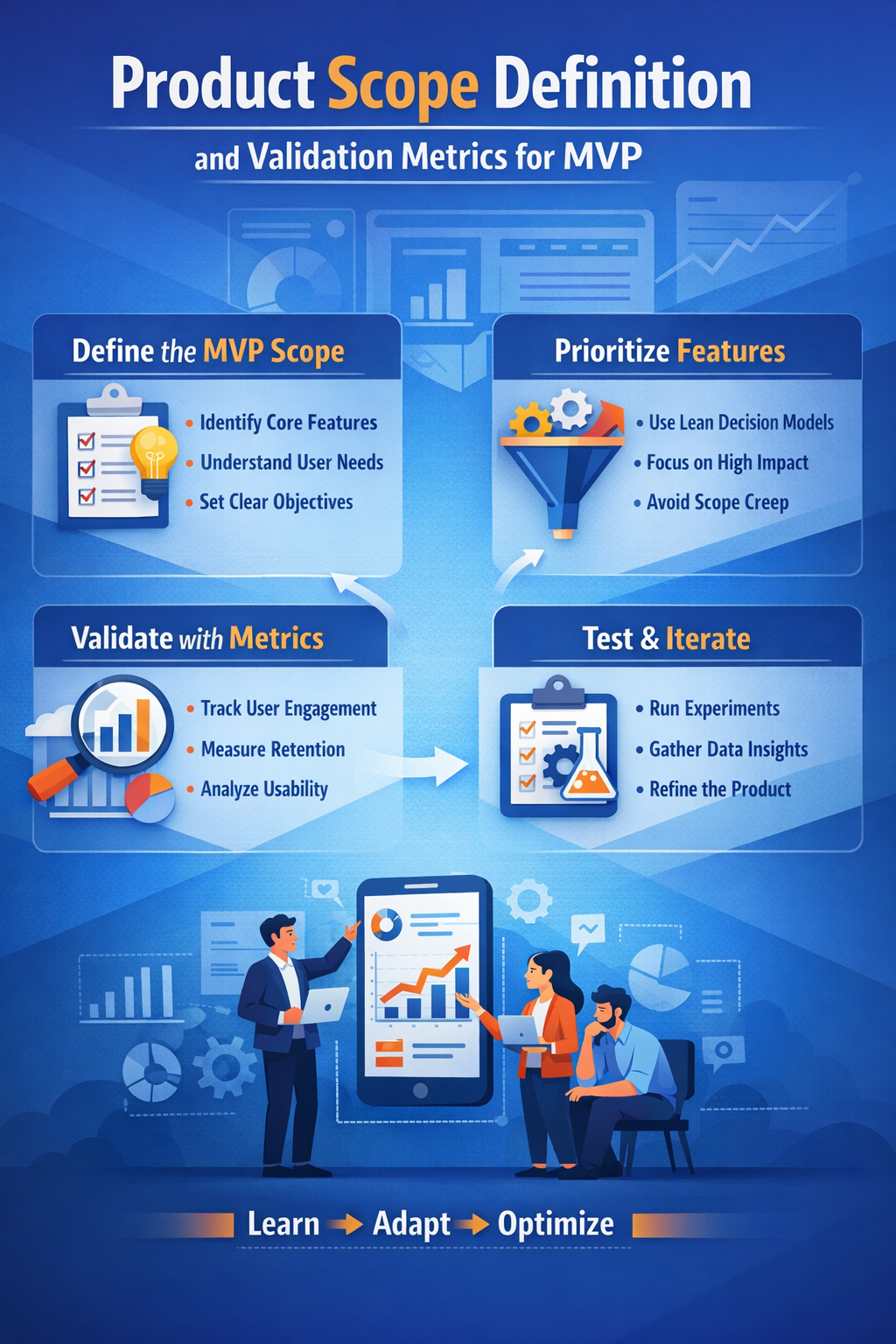
Defining the right product scope is the cornerstone of successful MVP development. Without disciplined scoping and measurable validation criteria, teams risk building features that neither solve real problems nor generate meaningful learning. An MVP is not merely a trimmed-down product; it is a structured experiment designed to validate assumptions under constrained resources. Organizations that approach this phase strategically reduce uncertainty, optimize investment, and accelerate product-market fit through deliberate planning, prioritization, and measurable outcomes.
Defining Product Scope in Early-Stage MVP Strategy
Product scope in an MVP context refers to the clearly articulated boundaries of functionality, user segments, technical architecture, and performance expectations that will be delivered in the first release. It is not a feature wishlist; it is a focused response to a specific hypothesis about user needs.
Effective scope definition begins with three foundational elements:
-
Problem clarity
-
Target audience precision
-
Value proposition alignment
The scope must translate the core problem into a minimal but testable solution. This means identifying the smallest feature set capable of delivering measurable user value. A common mistake is confusing minimal with incomplete. An MVP must deliver a coherent experience, even if its functionality is intentionally limited.
An experienced MVP App Development Company typically facilitates workshops to align stakeholders on objectives, constraints, and success criteria before defining scope boundaries. These early discussions prevent ambiguity later in development.
Clear documentation should include:
-
Core feature list
-
Non-goals and exclusions
-
User journey maps
-
Assumptions being tested
-
Technical constraints
This disciplined approach ensures that scope serves learning objectives rather than aesthetic or competitive impulses.
Identifying Core User Problems and Value Hypotheses
Every MVP begins with assumptions. The objective is not to confirm them blindly but to test them rigorously. To do so, teams must articulate explicit value hypotheses.
A value hypothesis answers three questions:
-
Who experiences the problem?
-
How significant is the problem?
-
Why will this solution meaningfully improve the situation?
User research methods that support this phase include:
-
Qualitative interviews
-
Behavioral observation
-
Survey-based validation
-
Competitive landscape analysis
These insights refine the problem statement and prevent feature creep. Instead of asking what features should be included, teams should ask what assumptions must be validated.
For example, if the hypothesis is that users struggle with time management in remote environments, the MVP should focus only on the smallest feature set that addresses scheduling friction. Features unrelated to this hypothesis should be deliberately excluded.
Precise hypothesis documentation transforms the MVP from a product exercise into an evidence-generating experiment.
Prioritizing Features Using Lean Decision Models
Feature prioritization is where scope discipline is tested. Multiple frameworks can guide decision-making, including:
-
MoSCoW method
-
RICE scoring
-
Kano model
-
Impact versus effort matrix
The guiding principle is alignment with validation goals. Features that do not directly test a hypothesis should not be included in the MVP.
An impact versus effort matrix is particularly effective at this stage. Features are evaluated based on:
-
User impact
-
Technical complexity
-
Resource requirement
-
Risk mitigation value
High-impact, low-effort features are ideal candidates. Low-impact or high-effort items should be deferred.
A structured prioritization process also improves financial planning. By focusing only on essential features, teams gain clearer visibility into MVP app development cost and can allocate resources efficiently without overengineering.
Involving product, design, and engineering stakeholders in prioritization discussions ensures balanced decisions grounded in feasibility and user value.
Establishing Clear Boundaries to Prevent Scope Creep
Scope creep is one of the primary risks in MVP initiatives. It occurs when new ideas, stakeholder requests, or competitive pressures gradually expand the feature set beyond its original intent.
Preventing scope creep requires:
-
A documented feature baseline
-
Formal change evaluation procedures
-
Clear approval workflows
-
Transparent communication channels
Each proposed addition should be evaluated against three criteria:
-
Does it test a critical assumption?
-
Does it materially affect validation metrics?
-
Does it delay the release timeline significantly?
If the answer to these questions is negative, the feature should be deferred.
A disciplined MVP App Development Company often maintains a structured backlog system where new ideas are logged but not automatically implemented. This maintains strategic focus without dismissing innovation.
Time constraints should also be treated as fixed variables. When deadlines are firm, scope must adjust accordingly rather than expanding timelines to accommodate feature growth.
Selecting Validation Metrics That Drive Insight
An MVP without metrics is merely a prototype. Validation metrics translate user interaction into actionable insight.
Metrics should be categorized into:
-
Acquisition metrics
-
Activation metrics
-
Engagement metrics
-
Retention metrics
-
Revenue metrics
The specific metrics chosen depend on the product model, but they must align with the hypothesis being tested.
For example:
-
If testing user interest, track sign-up conversion rates.
-
If testing usability, measure task completion rates.
-
If testing engagement, analyze session frequency and duration.
Vanity metrics, such as total downloads without active usage, should be avoided. The objective is learning, not superficial growth.
Key characteristics of effective MVP metrics include:
-
Measurable
-
Time-bound
-
Directly linked to user behavior
-
Capable of influencing strategic decisions
Establishing these metrics before development ensures instrumentation is embedded in the architecture rather than retrofitted later.
Designing Experiments to Test Product Assumptions
An MVP should be structured as a controlled experiment. Each feature or workflow should correspond to a specific testable assumption.
Experiment design involves:
-
Defining the hypothesis
-
Selecting the measurable outcome
-
Establishing baseline expectations
-
Determining success thresholds
For example, a team might hypothesize that at least 30 percent of new users will complete onboarding within five minutes. If actual results fall significantly below this threshold, the hypothesis requires refinement.
Controlled experiments may include:
-
A/B testing
-
Cohort analysis
-
Limited feature rollouts
-
Pilot user groups
The design phase must also account for sample size adequacy and statistical significance. Drawing conclusions from insufficient data can lead to premature scaling or unnecessary pivots.
When executed systematically, experimentation reduces reliance on intuition and replaces it with evidence-based iteration.
Measuring Market Fit Through Actionable Data
Product-market fit is not a single metric but a composite signal derived from user behavior patterns. Indicators may include:
-
Consistent retention over time
-
Organic referrals
-
Reduced churn
-
High feature adoption rates
One widely referenced method involves asking users how disappointed they would be if the product were no longer available. Strong positive responses often correlate with meaningful value delivery.
However, qualitative feedback must be paired with quantitative analysis. Behavioral data reveals what users actually do, not just what they say.
A data-informed feedback loop typically includes:
-
Usage analytics
-
User interviews
-
Support ticket analysis
-
In-app behavior tracking
Organizations offering mobile app development solutions frequently emphasize analytics integration from the initial build to ensure reliable data capture.
The key is not just gathering data but interpreting it within the context of original hypotheses. Metrics should inform iterative refinement rather than arbitrary feature expansion.
Financial Planning and Cost Control for MVP Phases
Financial discipline plays a critical role in MVP execution. Budgeting should align with learning objectives rather than long-term scaling ambitions.
Cost drivers typically include:
-
Design and user experience work
-
Backend and frontend development
-
Third-party integrations
-
Infrastructure setup
-
Quality assurance
-
Analytics implementation
Transparent cost estimation requires clear scope definition. Ambiguous requirements inflate budgets and introduce risk.
A structured approach to budgeting includes:
-
Feature-based cost breakdown
-
Contingency allocation
-
Milestone-based funding release
-
Performance-based continuation decisions
Understanding MVP app development cost requires recognizing that lower upfront investment does not mean lower quality. Instead, it reflects strategic limitation of scope.
A seasoned MVP App Development Company will often recommend phased investment, where continued funding depends on measurable validation success. This approach mitigates financial exposure while preserving innovation potential.
Effective cost control also involves avoiding premature optimization. Advanced scalability features, extensive automation, and non-essential integrations should typically be deferred until validation signals justify expansion.
Iterative Refinement and Data-Driven Roadmapping
After launch, the MVP enters its most critical phase: iteration. The purpose of this stage is to refine the product based on empirical evidence rather than assumptions.
Iteration cycles should be:
-
Short
-
Data-driven
-
Hypothesis-based
-
Outcome-measured
Each iteration must answer a specific question. For example:
-
Can onboarding completion rates be improved?
-
Does feature simplification increase engagement?
-
Will pricing adjustments impact retention?
Roadmaps should evolve dynamically based on findings. Instead of rigid annual planning, teams should maintain flexible quarterly objectives that reflect real-world feedback.
Prioritization during iteration should continue to rely on impact versus effort analysis. Enhancements that meaningfully improve validation metrics should receive priority over cosmetic or speculative changes.
A collaborative relationship between product managers, engineers, designers, and data analysts ensures that decisions remain aligned with measurable outcomes rather than internal preferences.
Conclusion
Defining product scope and establishing validation metrics are foundational disciplines in early-stage product development. By clearly articulating hypotheses, prioritizing features strategically, implementing measurable experiments, and maintaining financial discipline, organizations transform uncertainty into structured learning. A well-executed MVP is not simply a preliminary release; it is a strategic mechanism for reducing risk and generating evidence. When teams treat scope and validation as interconnected processes, they create a reliable pathway from initial concept to sustainable growth.
 Turkish
 English
 Arabic
 French
 Spanish
 Portuguese
 Deutsch
 Dutch
Dutch
 Italiano
 Russian
 Romaian
 Portuguese (Brazil)
 Greek
Greek
