


 Pro Benefits
 About
About
 Voorwaarden
 Privacy
 Child Safety & Protection
 Meldingen
 Ayrush Global It Services Pvt Ltd
Best Salesforce Learning Path for Non-IT Professionals
Introduction
Salesforce is a cloud-based customer relationship management (CRM) platform used by organizations worldwide to manage sales, service, marketing, and business processes. For non-IT professionals, Salesforce offers a structured, role-based learning ecosystem that allows individuals to transition into technology-focused careers without requiring prior coding or software engineering experience. By following a progressive learning path that starts with CRM fundamentals, advances through system configuration, and builds toward certification and real-world projects, learners can become job-ready Salesforce Administrators or System Admins within a defined and achievable timeframe.
This guide outlines a comprehensive, step-by-step Salesforce learning path designed specifically for professionals from non-technical backgrounds. It focuses on practical skills, industry-aligned certifications, and career-oriented training strategies that align with job roles such as Salesforce Administrator, Salesforce System Admin, and CRM Operations Specialist.
Why Salesforce Is an Ideal Career Path for Non-IT Professionals
Salesforce stands out among enterprise platforms because of its low-code and no-code capabilities. This means many core tasks such as managing users, creating workflows, building dashboards, and automating processes can be done through configuration rather than traditional programming.
Key Advantages for Non-IT Learners
-
Business-Focused Roles: Many Salesforce roles focus on process improvement, data management, and user support rather than software development.
-
Structured Learning Ecosystem: Salesforce provides official learning paths, certifications, and hands-on environments for practice.
-
High Market Demand: Organizations across industries rely on Salesforce, creating strong demand for trained administrators and system managers.
-
Clear Career Progression: Learners can start as Salesforce Admins and move into Business Analyst, Consultant, or Platform Manager roles over time.
For working professionals from backgrounds such as sales, marketing, customer service, HR, finance, or operations, Salesforce offers a natural transition into IT-adjacent, technology-driven careers.
Understanding Salesforce and Its Core Components
Before starting any formal training, it is important to understand what Salesforce is and how it is used in real organizations.
What Is Salesforce?
Salesforce is a cloud-based platform that helps businesses manage customer data, automate workflows, track performance, and improve customer experiences. It includes tools for:
-
Sales management (Sales Cloud)
-
Customer support and service (Service Cloud)
-
Marketing automation (Marketing Cloud)
-
Analytics and reporting
-
Application development and automation
Key Concepts Every Beginner Should Learn
-
Objects and Records: How data is stored and structured
-
Users and Profiles: How access and permissions are managed
-
Workflows and Automation: How business processes are automated
-
Reports and Dashboards: How performance is tracked and visualized
-
Security and Data Management: How information is protected
These concepts form the foundation of the Salesforce Admin and Salesforce System Admin roles.
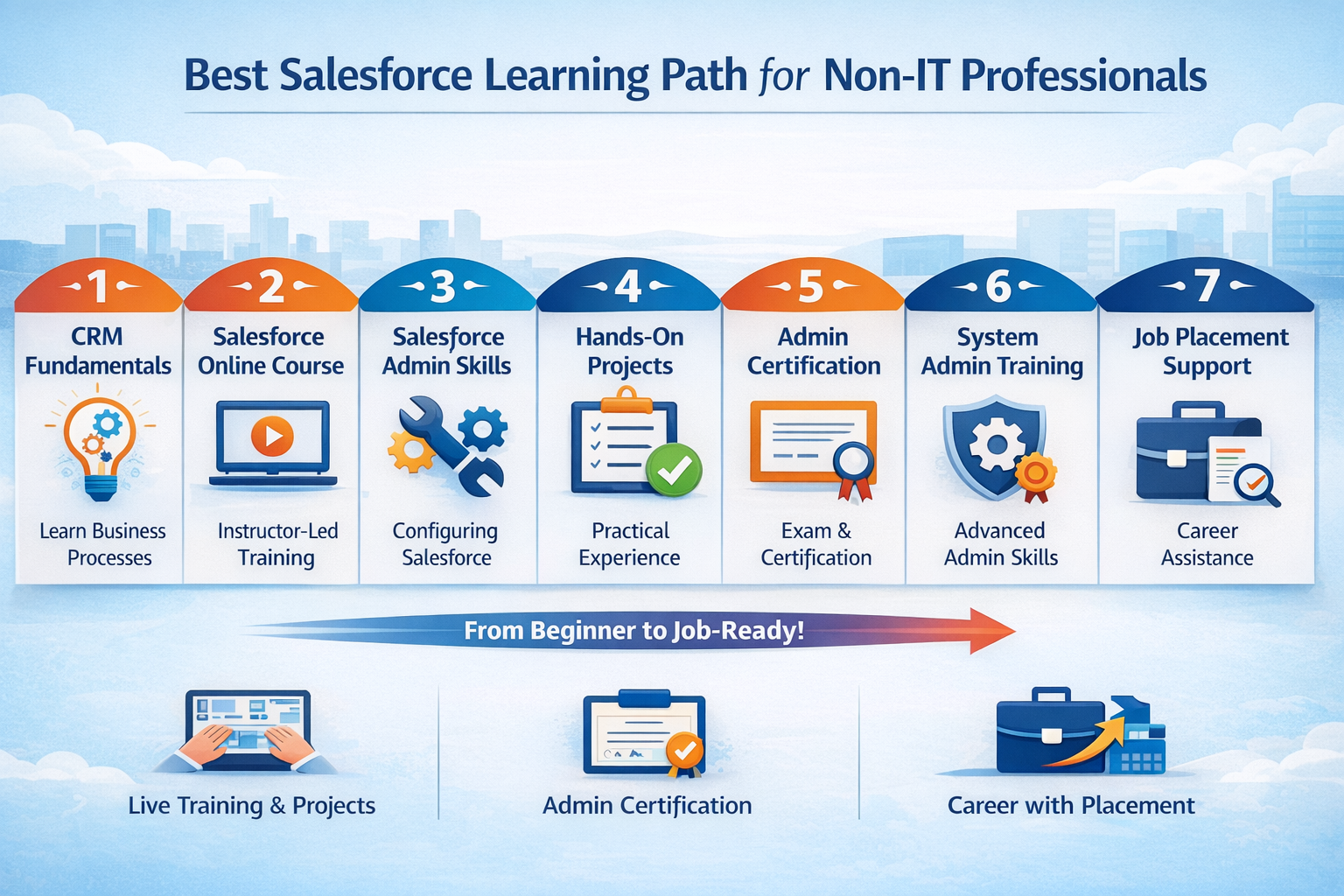
Step 1: Build CRM and Business Process Fundamentals
Non-IT professionals often have a strong advantage when it comes to understanding business workflows. This step focuses on translating that knowledge into CRM concepts.
What to Learn in This Phase
-
Basics of customer relationship management
-
Sales and service lifecycle processes
-
Data organization and record management
-
Role-based access and business rules
-
Reporting and performance tracking
Why This Step Matters
Salesforce is not just a technical tool. It is a business platform designed to support real-world processes. Understanding how departments such as sales, support, and marketing operate helps learners configure Salesforce in ways that align with organizational goals.
Step 2: Enroll in a Structured Salesforce Online Course
A well-designed Salesforce online course provides guided instruction, practical exercises, and access to live support. For non-IT professionals, structured learning is essential to avoid confusion and ensure consistent progress.
What to Look for in a Salesforce Online Course
-
Step-by-step curriculum from beginner to advanced
-
Hands-on labs and sandbox access
-
Real-world business case studies
-
Live instructor-led sessions
-
Career guidance and certification support
A quality course bridges the gap between theoretical knowledge and workplace application.
Step 3: Learn Salesforce Admin Fundamentals
The Salesforce Administrator role is the most common entry point for non-IT professionals. It focuses on configuring and maintaining the platform rather than developing code.
Core Topics in a Salesforce Admin Course
-
User management and access control
-
Standard and custom objects
-
Page layouts and record types
-
Data import and export
-
Validation rules and workflows
-
Email templates and automation tools
-
Reports and dashboards
Practical Skills Gained
By the end of this phase, learners should be able to set up a Salesforce system for a small business, manage users, automate basic processes, and generate meaningful reports for stakeholders.
Step 4: Hands-On Practice Through Real Projects
Theory alone is not enough to become job-ready. Practical experience is what employers value most.
Types of Projects to Work On
-
Building a CRM system for a fictional sales team
-
Creating automated workflows for customer support cases
-
Designing dashboards for management reporting
-
Managing user roles and data security for a growing company
These projects simulate real-world job tasks and help learners build a professional portfolio.
Step 5: Salesforce Admin Certification Preparation
Salesforce certifications validate your skills and improve your job prospects. The most recommended certification for beginners is the Salesforce Administrator Certification.
What the Exam Covers
-
Organization setup
-
User and security management
-
Standard and custom objects
-
Sales and service applications
-
Data management and analytics
-
Workflow and automation
How to Prepare Effectively
-
Review official exam guides
-
Take practice tests
-
Join study groups
-
Work on real-life scenarios rather than memorization
Many learners also benefit from enrolling in Salesforce admin certification classes that offer structured exam preparation and mentor support.
Step 6: Transition to Salesforce System Admin Skills
After mastering the basics of administration, learners can expand into the Salesforce System Admin role. This role focuses on platform stability, security, and performance.
Advanced Topics to Learn
-
Role hierarchy and sharing rules
-
Data security models
-
Backup and recovery strategies
-
System audits and monitoring
-
Integration basics with other tools
-
Advanced automation tools
This phase prepares learners for more responsibility and higher-level roles within organizations.
Step 7: Career-Focused Salesforce Training with Placement Support
For non-IT professionals, career transition can be challenging without proper guidance. This is where salesforce training with placement becomes critical.
What Placement-Oriented Training Includes
-
Resume and LinkedIn profile optimization
-
Mock interviews and technical assessments
-
Career counseling sessions
-
Employer networking support
-
Job referral programs
This approach ensures learners are not only technically skilled but also professionally prepared to enter the job market.
Career Roles After Completing the Salesforce Learning Path
Entry-Level Roles
-
Salesforce Administrator
-
CRM Support Specialist
-
Salesforce Operations Analyst
Mid-Level Roles
-
Salesforce Business Analyst
-
Salesforce Consultant
-
Platform Support Manager
Long-Term Career Growth
With experience and advanced certifications, professionals can move into roles such as Solution Architect, CRM Program Manager, or Salesforce Practice Lead.
Salary Growth and Market Demand
Salesforce professionals are in high demand across industries such as healthcare, finance, retail, and technology.
Salary Trends
-
Entry-level Salesforce Admins typically earn competitive starting salaries compared to other non-technical IT roles.
-
Mid-level professionals with certifications and project experience see steady growth.
-
Advanced roles such as consultants and architects command significantly higher compensation.
Market research consistently shows strong hiring trends for certified Salesforce professionals.
Common Challenges for Non-IT Learners and How to Overcome Them
Fear of Technology
Many non-IT professionals worry about technical complexity. Salesforce’s user-friendly interface and no-code tools make it accessible to beginners.
Time Management
Balancing work, learning, and personal life can be challenging. Structured schedules and live sessions help maintain consistency.
Certification Anxiety
Mock exams, mentor support, and peer study groups can reduce stress and improve performance.
Recommended Learning Timeline
Month 1–2
-
CRM fundamentals
-
Salesforce platform basics
-
Navigation and data management
Month 3–4
-
Salesforce Admin course
-
Hands-on projects
-
Reporting and automation
Month 5
-
Certification preparation
-
Practice exams
-
Resume and interview preparation
Month 6
-
Job applications
-
Mock interviews
-
Placement support and networking
This timeline can be adjusted based on individual availability and learning speed.
Why Structured Training Matters for Career Transition
Self-learning is valuable, but structured programs provide accountability, expert guidance, and career-focused outcomes. For non-IT professionals, this structure reduces confusion and accelerates job readiness.
H2K Infosys designs its Salesforce learning programs to combine technical training, hands-on projects, and career development services. This integrated approach helps learners move from beginner to professional with confidence and practical experience.
Key Takeaways
-
Salesforce is a business-focused platform ideal for non-IT professionals.
-
The Salesforce Administrator role is the best entry point.
-
Structured salesforce online course programs provide guided learning and practical exposure.
-
Certification improves credibility and job opportunities.
-
Salesforce System Admin skills enable career growth into higher-level roles.
-
Salesforce training with placement support helps bridge the gap between learning and employment.
Conclusion
The best Salesforce learning path for non-IT professionals is one that combines business understanding, technical configuration skills, hands-on project experience, and certification-backed credibility. By starting with CRM fundamentals, progressing through a comprehensive salesforce admin course, and advancing into Salesforce System Admin responsibilities, learners can build a sustainable and rewarding career in the Salesforce ecosystem.
With structured training, mentorship, and placement-oriented support from platforms like H2K Infosys, working professionals can confidently transition into Salesforce roles and position themselves for long-term growth in the global IT job market.
 Dutch
Dutch
 English
 Arabic
 French
 Spanish
 Portuguese
 Deutsch
 Turkish
 Italiano
 Russian
 Romaian
 Portuguese (Brazil)
 Greek
Greek
