


 Pro Benefits
 About
About
 Termini e Condizioni
 Privacy
 Child Safety & Protection
 Notifiche
 Ayrush Global It Services Pvt Ltd
Critical Thinking Exercises That Help You Think Clearly Every Day
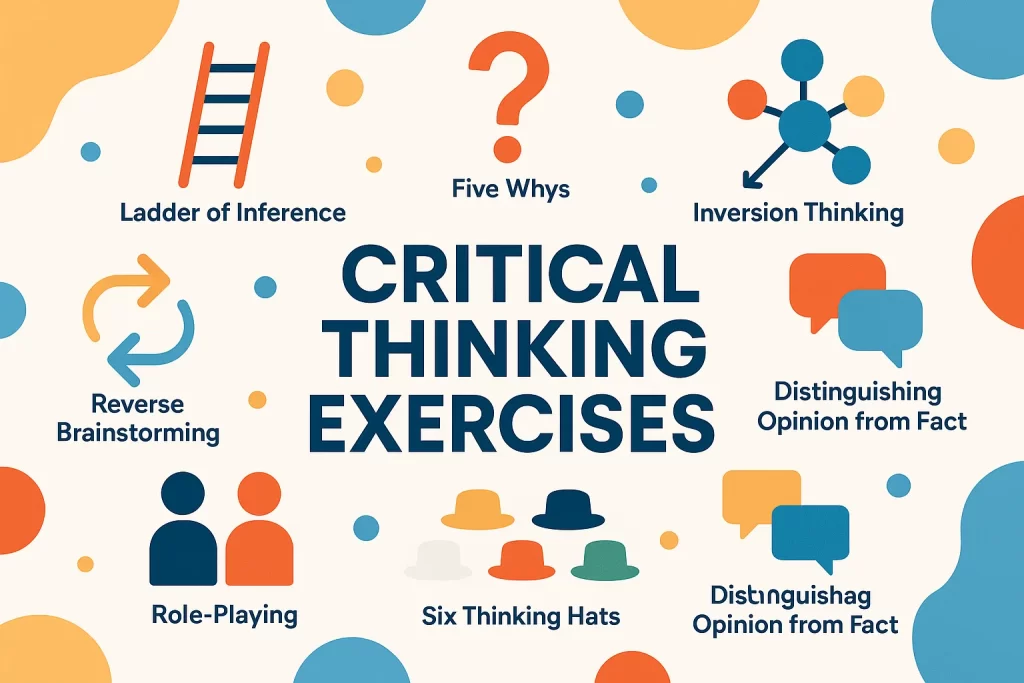
Critical thinking is an essential skill in today’s fast-moving world, helping people make better decisions and understand situations more clearly. By practicing Critical Thinking Exercises regularly, individuals can learn how to analyze information, question assumptions, and respond thoughtfully instead of reacting emotionally or impulsively.
In everyday life, from solving simple problems to making important choices, Critical Thinking Exercises encourage a deeper level of understanding and awareness. Rather than accepting information at face value, these exercises help people slow down, reflect on different perspectives, and develop stronger reasoning skills over time.
What Are Critical Thinking Exercises?
Critical thinking exercises are structured activities that train the mind to analyze information, evaluate evidence, and form logical conclusions. Unlike memorization-based learning, these exercises focus on how you think rather than what you think.
They encourage you to question assumptions, identify patterns, and recognize bias. Over time, practicing such exercises strengthens your ability to make fair and informed decisions in both personal and professional life.
Why Critical Thinking Matters in Daily Life
Critical thinking is not limited to classrooms or exams. We use it every day, often without realizing it.
For example, when choosing between two job offers, you compare salary, growth opportunities, location, and work-life balance. When reading a news article, you decide whether the information is reliable or emotionally misleading. These moments require thoughtful evaluation, which is exactly what critical thinking supports.
People who practice critical thinking tend to communicate better, solve problems faster, and feel more confident in their choices.
Simple Critical Thinking Activities You Can Try
You don’t need complex tools to improve your thinking skills. Small, consistent practices can make a big difference.
1. Asking “Why” and “How”
Whenever you come across information, ask yourself why it is presented that way and how the conclusion was reached. This habit helps uncover hidden assumptions and incomplete reasoning.
2. Pros and Cons Lists
Before making a decision, write down the advantages and disadvantages of each option. This simple exercise encourages balanced thinking and reduces emotional bias.
3. Perspective Switching
Try to look at a situation from someone else’s point of view. This builds empathy and helps you understand why others may think differently.
Real-Life Examples of Critical Thinking in Action
Imagine a student struggling with low exam scores. Instead of blaming intelligence or luck, critical thinking encourages the student to analyze study habits, time management, and understanding of concepts. By identifying the real cause, the student can make practical improvements.
In the workplace, a team facing repeated project delays may assume workload is the issue. A critical approach would examine communication gaps, unclear goals, or unrealistic timelines before jumping to conclusions.
How Critical Thinking Exercises Improve Learning
Critical thinking exercises help learners move beyond surface-level understanding. Instead of memorizing facts, learners begin connecting ideas and applying knowledge in new situations.
This approach improves long-term retention and builds confidence. Learners become active participants rather than passive receivers of information. Over time, they develop the ability to solve unfamiliar problems independently.
Common Mistakes to Avoid While Practicing Critical Thinking
One common mistake is overthinking simple situations. Critical thinking should bring clarity, not confusion. Another mistake is ignoring emotions completely. While logic is important, emotions also provide valuable information and should be considered thoughtfully.
It’s also important to remain open-minded. Critical thinking is not about proving yourself right; it’s about understanding the situation as clearly as possible.
Building a Habit of Thoughtful Thinking
Like any skill, critical thinking improves with regular practice. Start small by reflecting on daily decisions, conversations, or challenges. Ask yourself what information influenced your choice and whether there were alternative options.
Over time, these small habits add up, making thoughtful analysis a natural part of your thinking process.
Conclusion
Critical thinking exercises help you slow down, reflect, and make better choices in everyday life. They encourage curiosity, fairness, and logical reasoning without pressure or complexity. By practicing simple critical thinking activities regularly, you can improve how you learn, communicate, and solve problems. In a fast-paced world, thoughtful thinking is not just a skill—it’s a valuable mindset that supports personal growth and clearer understanding.
 Italiano
 English
 Arabic
 French
 Spanish
 Portuguese
 Deutsch
 Turkish
 Dutch
Dutch
 Russian
 Romaian
 Portuguese (Brazil)
 Greek
Greek
