


 Pro Benefits
 Über
Über
 Bedingungen
 Datenschutz
 Child Safety & Protection
 Benachrichtigungen
 Ayrush Global It Services Pvt Ltd
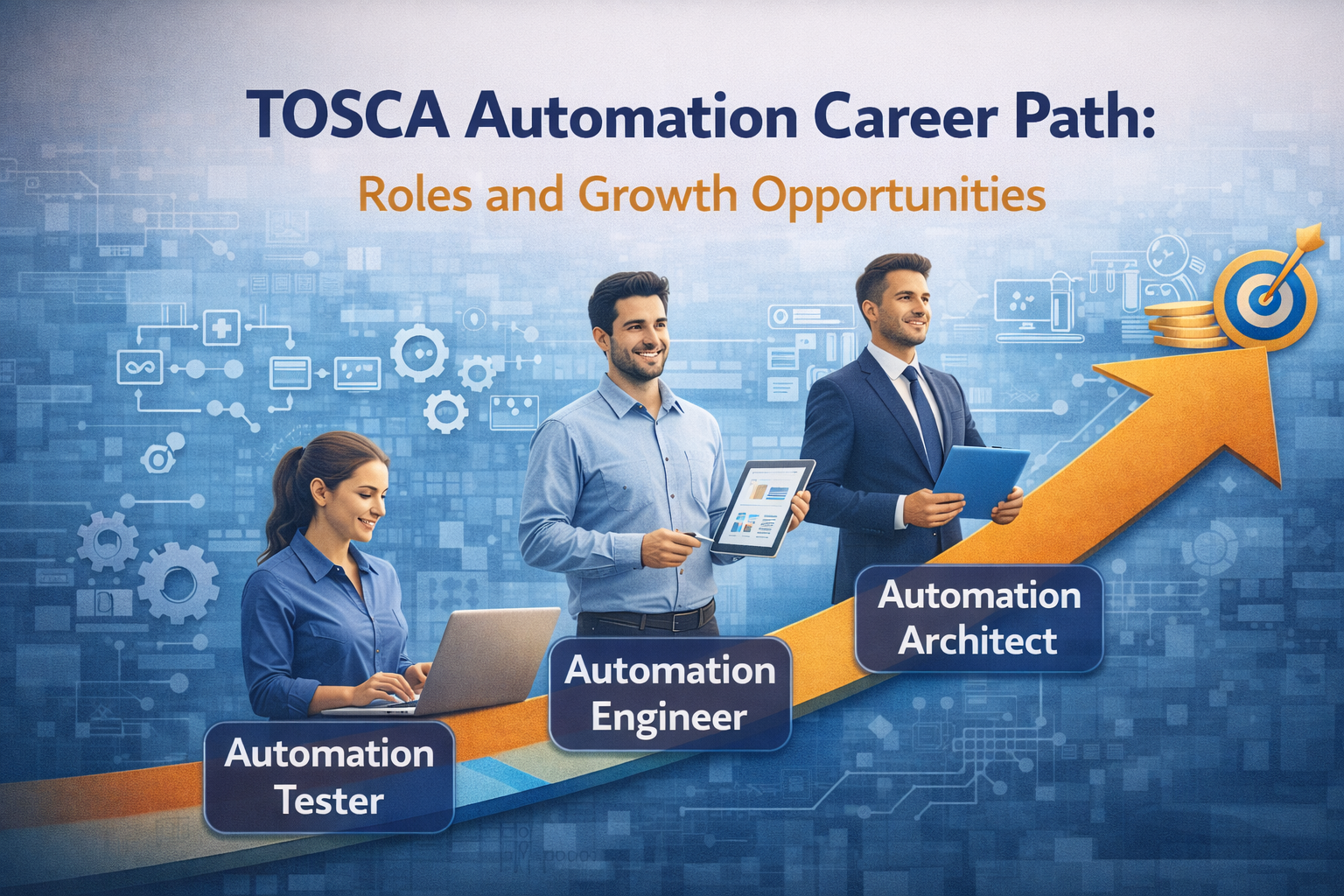
TOSCA Automation Career Path: Roles and Growth Opportunities
What is the TOSCA Automation Career Path?
The TOSCA Automation career path refers to the structured progression of roles and responsibilities that IT professionals can pursue after gaining expertise in Tricentis TOSCA, a leading test automation tool. TOSCA enables enterprise organizations to automate software testing across functional, regression, and API layers. Professionals in this field typically start with foundational automation testing knowledge and gradually advance to specialized and leadership positions within quality engineering teams. Obtaining a TOSCA Automation Certification validates a candidate’s proficiency, providing a structured pathway for career growth in automation testing.
How does TOSCA work in real-world IT projects?
Tricentis TOSCA is widely used in enterprise IT environments to streamline test automation. It follows a model-based testing approach, where testers design reusable modules called TestCases and Modules, which represent individual application functions. These modules can be combined to create complex test scenarios, making test maintenance efficient and scalable.
In practical projects:
-
Testers start by analyzing requirements and identifying automation candidates.
-
TOSCA modules are created using the tool’s scanning and recording features.
-
TestCases are executed across multiple environments, including web, desktop, and API layers.
-
Execution logs and reporting dashboards are reviewed to track defects and test coverage.
This approach reduces manual effort, improves regression testing efficiency, and ensures consistency across releases.
Why is a TOSCA Automation Career Important for IT Professionals?
Automation is a critical aspect of modern software delivery. With the increasing adoption of Agile and DevOps practices, organizations rely on automation engineers to:
-
Improve testing efficiency and reduce manual errors.
-
Enable faster software releases while maintaining quality.
-
Support continuous integration (CI) and continuous delivery (CD) pipelines.
TOSCA-specific skills are highly valued because the tool integrates well with CI/CD platforms like Jenkins, Azure DevOps, and Git, providing measurable ROI for enterprises. Professionals skilled in TOSCA are positioned to support both development and quality assurance teams, bridging functional testing with enterprise-level automation strategies.
What Skills Are Required to Learn TOSCA Automation?
Learning TOSCA involves both technical and analytical skills. Key requirements include:
-
Software Testing Fundamentals: Knowledge of QA methodologies, SDLC, STLC, and defect lifecycle.
-
TOSCA Tool Skills: Creating modules, building test cases, designing business components, and executing automation.
-
Scripting & Data Management: Familiarity with basic scripting concepts and test data management for parameterized testing.
-
Integration Knowledge: Understanding of CI/CD tools (Jenkins, Azure DevOps) and test management systems (JIRA, ALM).
-
Analytical Thinking: Ability to design modular, reusable, and maintainable test automation frameworks.
Professionals often gain these skills through a structured TOSCA Automation Course, which combines hands-on exercises with real-world examples.
How is TOSCA Used in Enterprise Environments?
TOSCA is commonly applied across multiple enterprise contexts:
-
Regression Testing: Automated regression suites ensure that software updates do not break existing functionality.
-
API Testing: TOSCA enables automated API validation using JSON, SOAP, and REST protocols.
-
Data-Driven Testing: TOSCA supports external test data sources such as Excel, CSV, and databases, enabling dynamic test execution.
-
Integration with CI/CD Pipelines: Automated tests are triggered as part of build pipelines, improving release velocity and quality assurance.
Enterprises benefit from TOSCA’s model-based approach, which emphasizes reusability and reduces long-term maintenance costs. Teams typically structure TOSCA projects in a layered format modules, business components, test cases, and execution lists to maintain organization and scalability.
What Job Roles Use TOSCA Daily?
Professionals trained in TOSCA may assume various roles, including:
|
Role |
Responsibilities |
Typical Experience Level |
|
TOSCA Test Automation Engineer |
Design, execute, and maintain automated test cases; collaborate with QA teams |
Beginner to Intermediate |
|
TOSCA Automation Consultant |
Implement TOSCA frameworks, optimize test strategy for clients |
Intermediate to Advanced |
|
QA Analyst / QA Engineer |
Perform functional testing and automate repetitive tasks |
Beginner to Intermediate |
|
Automation Architect |
Define enterprise automation strategies, oversee framework design |
Advanced |
|
Test Manager / Lead |
Manage automation projects, coordinate teams, ensure quality standards |
Advanced |
What Careers Are Possible After Learning TOSCA?
The career trajectory in TOSCA is flexible and allows growth across multiple dimensions:
-
Technical Specialist Path:
-
Entry: TOSCA Test Automation Engineer
-
Mid-Level: Senior Test Automation Engineer / Automation Consultant
-
Advanced: Automation Architect / Technical Lead
Management Path:
-
Entry: QA Analyst with TOSCA expertise
-
Mid-Level: QA Lead / Test Manager
-
Advanced: QA Director / Head of Automation
Enterprise Integration Specialist Path:
-
Focus on CI/CD integration, API automation, and enterprise-wide automation frameworks.
Professionals can combine TOSCA expertise with domain knowledge (banking, insurance, healthcare) to enhance their career prospects. Organizations often seek engineers who can integrate automation across teams and systems, providing opportunities for specialized roles in large-scale IT projects.
FAQ / Q&A
Q1. What is TOSCA Automation Certification?
A1. TOSCA Automation Certification validates a professional’s ability to design, implement, and maintain automated tests using Tricentis TOSCA. It demonstrates proficiency in model-based testing, test management, and integration with CI/CD tools.
Q2. How long does it take to learn TOSCA?
A2. Learning TOSCA typically takes 6–12 weeks for beginners, depending on prior testing experience and course intensity. Hands-on practice and real-world project exercises accelerate learning.
Q3. Is coding required for TOSCA automation?
A3. Minimal coding is required because TOSCA uses a model-based approach. However, understanding basic scripting, data handling, and API protocols is beneficial.
Q4. What industries use TOSCA?
A4. TOSCA is widely adopted in banking, finance, healthcare, retail, and IT services where complex software applications require automated regression and API testing.
Q5. Can TOSCA skills help in DevOps roles?
A5. Yes, TOSCA integrates with CI/CD pipelines, allowing automation engineers to contribute to continuous testing processes, which is a core DevOps practice.
Tools and Frameworks Related to TOSCA
|
Tool / Framework |
Purpose |
Enterprise Use Case |
|
Jenkins |
CI/CD integration |
Trigger TOSCA test execution after code build |
|
JIRA / ALM |
Test management |
Track defects and execution reports |
|
Docker / Kubernetes |
Test environment management |
Execute tests in isolated containers |
|
API Testing Tools |
REST/SOAP validation |
Complement TOSCA API automation modules |
Key Takeaways
-
TOSCA enables enterprise-grade test automation using model-based testing.
-
Career opportunities include automation engineer, consultant, architect, and test manager roles.
-
Skills required include testing fundamentals, TOSCA tool proficiency, scripting basics, and CI/CD integration.
-
Structured learning through a Tricentis TOSCA Training program enhances real-world readiness.
-
TOSCA expertise supports multiple industries and aligns with DevOps practices for continuous testing.
Explore H2K Infosys TOSCA Automation Course to gain practical skills and certification guidance.Advance your career in IT automation with hands-on training and structured learning paths.
 Deutsch
 English
 Arabic
 French
 Spanish
 Portuguese
 Turkish
 Dutch
Dutch
 Italiano
 Russian
 Romaian
 Portuguese (Brazil)
 Greek
Greek
