


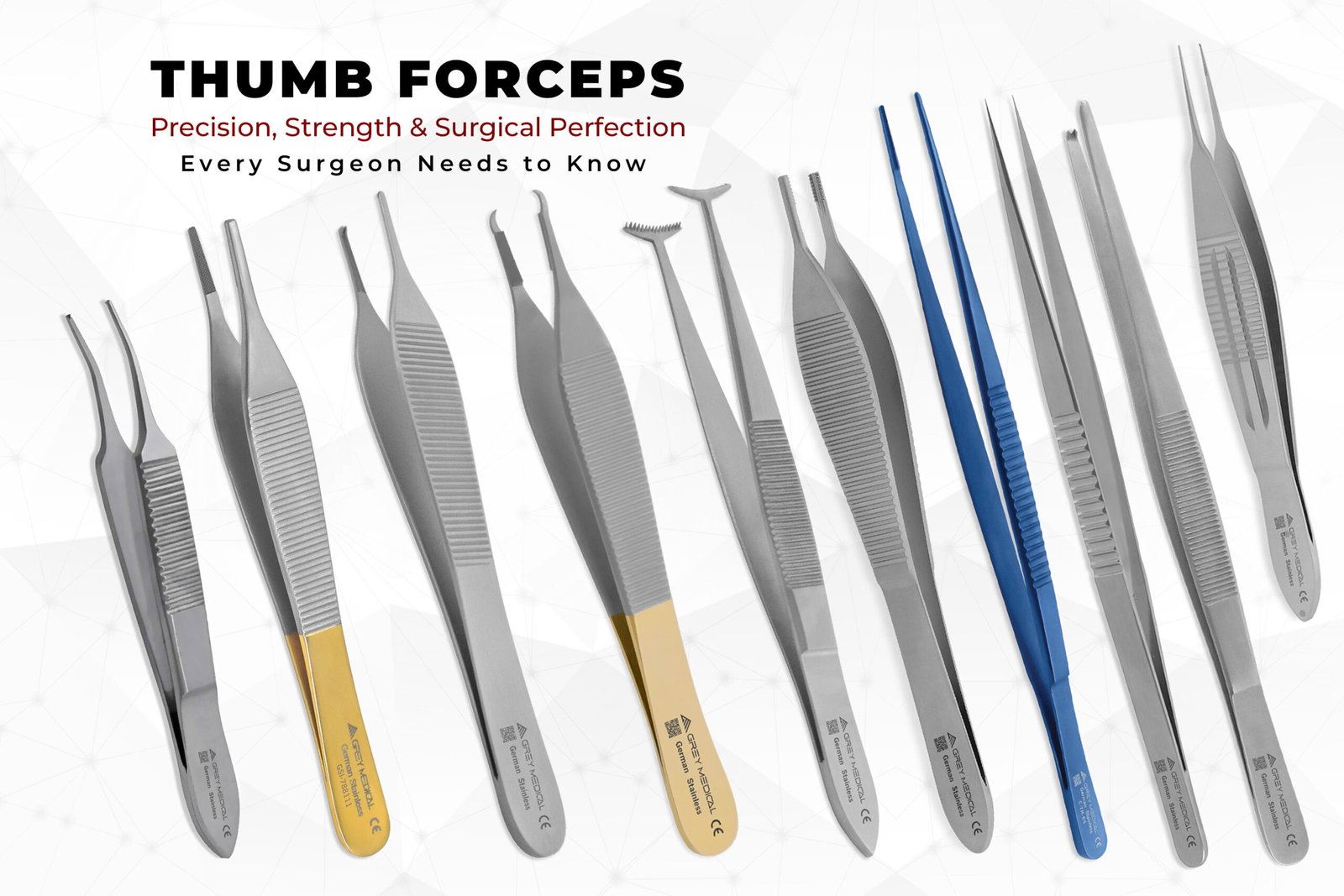
Thumb forceps are essential surgical instruments that help medical professionals handle tissue, hold dressings, and perform delicate procedures with accuracy. Their simple, tweezer-like design allows surgeons to control small objects and tissue without using a locking mechanism. However, different designs serve different purposes. Understanding the various thumb forceps types helps medical professionals select the right instrument for specific surgical and clinical applications.
What Are Thumb Forceps?
Thumb forceps are handheld instruments that feature two spring-action arms joined at one end. The user squeezes the arms together to grip an object and releases them to open. Unlike locking forceps, thumb forceps do not use a ratchet mechanism, which allows professionals to adjust their grip quickly and easily.
Moreover, manufacturers produce these instruments in different shapes, sizes, tip configurations, and materials. These variations allow healthcare professionals to handle tissue, gauze, sutures, and other materials during medical procedures.
Common Types of Thumb Forceps
Several designs serve different purposes in medical and surgical settings. Each type offers unique features that support precision and control.
1. Adson Thumb Forceps
Adson forceps feature a short, broad handle and a narrow tip. Many models include fine teeth that provide a secure grip on tissue. Therefore, surgeons often use them during wound closure and other procedures that require controlled tissue handling.
2. Adson-Brown Thumb Forceps
Adson-Brown forceps feature multiple fine teeth arranged across their gripping surface. This design provides a stable hold and helps distribute gripping pressure across a wider area. Consequently, professionals may use them when handling delicate tissue during surgical procedures.
3. Dressing Thumb Forceps
Dressing forceps typically feature smooth tips without teeth. As a result, they work well for holding gauze, applying dressings, and handling materials without engaging tissue with toothed edges. Their smooth gripping surfaces make them suitable for routine clinical tasks.
4. DeBakey Thumb Forceps
DeBakey forceps feature fine, atraumatic serrations designed to support delicate tissue handling. Medical professionals commonly associate these instruments with vascular and cardiovascular procedures. Their specialized gripping pattern helps provide control while minimizing unnecessary tissue trauma.
5. Rat-Tooth Thumb Forceps
Rat-tooth forceps feature pointed interlocking teeth at the tips. These teeth help secure tissue and reduce slipping during handling. In addition, their gripping design supports procedures that require a firmer hold, such as wound closure and certain surgical applications.
How to Choose the Right Thumb Forceps
Choosing the correct instrument depends on the procedure, tissue type, and required level of precision. For example, fine-tipped forceps may suit delicate tasks, while toothed designs provide a firmer grip on tissue. Smooth forceps, on the other hand, work well for dressings and materials.
Furthermore, professionals should consider the instrument's length, tip alignment, balance, finish, and material quality. Stainless steel construction remains a popular choice because it offers durability, corrosion resistance, and suitability for repeated sterilization when handled according to manufacturer instructions.
Care and Maintenance of Thumb Forceps
Proper maintenance helps preserve instrument performance and extends its service life. After use, medical staff should follow established cleaning, inspection, and sterilization protocols. They should also check the tips for alignment, wear, corrosion, or damage.
Additionally, healthcare teams should store instruments in a clean, dry environment and avoid placing heavy items on delicate tips. Regular inspection helps identify problems before they affect instrument functionality.
Conclusion
Different thumb forceps types offer specialized features for tissue handling, dressing applications, and surgical precision. From Adson and Adson-Brown designs to DeBakey, dressing, and rat-tooth forceps, each variation supports different clinical needs. Selecting the appropriate instrument and maintaining it properly can help healthcare professionals promote consistency, precision, and efficient workflows.
Grey Medical® is a privately owned medical technology company dedicated to innovation and excellence in the craft of surgical instrument. Through attention to design, quality, and functionality, Grey Medical® supports the importance of dependable surgical instruments in modern medical practice. Understanding thumb forceps variations helps professionals make informed decisions when selecting instruments for their clinical environments.


