


 Pro Benefits
 About
About
 Terms
Terms
 Privacy
 Child Safety & Protection
 Notifications
 Ayrush Global It Services Pvt Ltd
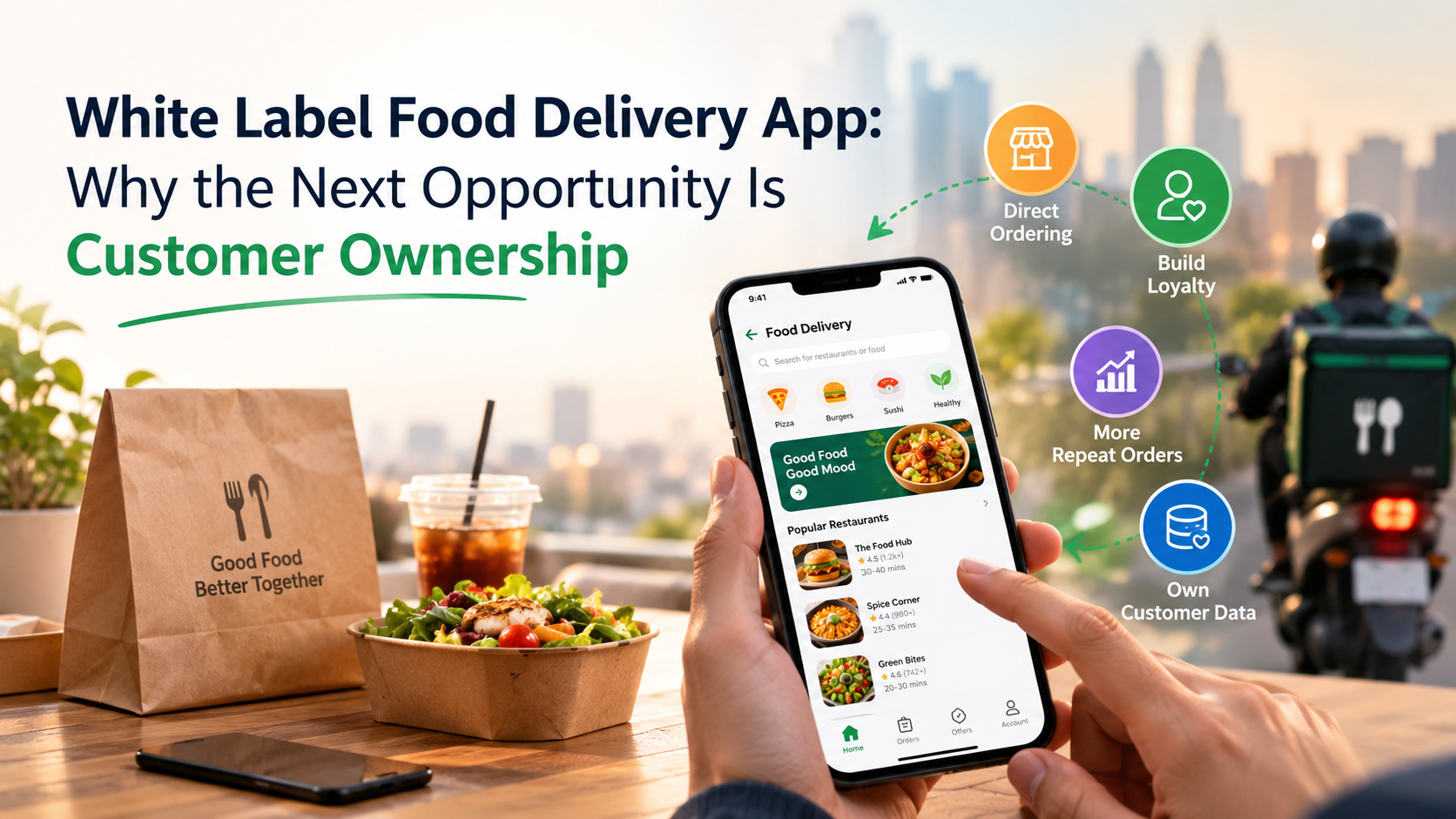
White Label Food Delivery App: Why the Next Opportunity Is Customer Ownership
For years, food delivery businesses competed on one obvious question: How quickly can you get food from a restaurant to a customer?
That question still matters. But it is no longer enough.
The food delivery market is moving into a different phase where customer relationships, repeat ordering, loyalty, direct channels, and data are becoming just as important as delivery speed. Restaurants increasingly want the reach of marketplaces without depending entirely on channels they do not control. Recent industry discussions show growing interest in first-party digital ordering as restaurants look for greater control over customer relationships and their digital sales channels.
This is where a white label food delivery app becomes more interesting than simply being another delivery application.
The Real Value Is Not the App
A white label food delivery app is often marketed as a shortcut to launching a delivery business. That description is too narrow.
The bigger opportunity is to create a branded ordering channel around a specific market.
An entrepreneur could build a food marketplace for a particular city. A restaurant group could create a shared ordering experience across multiple outlets. A regional food business could connect restaurants, customers, drivers, promotions, and loyalty under one identity.
Technology becomes the infrastructure. The business model becomes the differentiator.
This distinction matters because food delivery is becoming increasingly competitive. Large marketplaces already have enormous consumer awareness and restaurant networks. Trying to copy their scale immediately is unrealistic for most new businesses.
A smarter approach is to find a market where a focused proposition can win.
First-Party Ordering Is Changing the Conversation
Third-party marketplaces remain valuable for customer acquisition. But restaurants are increasingly interested in what happens after the first order.
Who owns the customer relationship?
Who understands repeat purchasing behavior?
Who can create a loyalty offer?
Who decides how the customer is contacted after the order?
These questions are pushing first-party ordering higher on the restaurant technology agenda.
A white label food delivery app can support this shift by giving a business its own branded customer touchpoint rather than making the marketplace brand the only recognizable destination.
That creates room for businesses to build their own loyalty strategy, promotions, customer journeys, and repeat-order campaigns.
The objective is not necessarily to eliminate third-party marketplaces. It is to avoid making them the entire business.
The Next Food Delivery Battle May Be About Repeat Customers
Getting a first order is only one part of economics.
The more valuable customer is often the one who orders again.
The 2026 DoorDash and SevenRooms restaurant trends report highlights how strongly restaurant relationships cross channels. Its research found that 80% of dine-in visits and 79% of orders were with restaurants customers had already tried. It also found that 87% of consumers said a credit, discount, or perk influenced them to reorder.
This changes how food delivery businesses should think about their technology.
Instead of building around transaction volume alone, businesses can design around customer frequency.
That could mean personalized offers for inactive customers, loyalty rewards for frequent buyers, recommendations based on previous orders, location-based promotions, or incentives that encourage customers to move between delivery and pickup.
The app becomes a relationship channel rather than simply an order form.
AI Is Moving Into Food Discovery
Another major shift is happening before the customer even opens a food delivery app.
AI is increasingly influencing how people discover restaurants. DoorDash's 2026 research found that 22% of surveyed consumers had used AI to choose a restaurant, while AI-generated restaurant recommendations were increasingly drawing information from digital listings and delivery platforms.
For food delivery businesses, this creates a new marketing question:
Can your restaurant data be understood and discovered across AI-driven search experiences?
Menus, restaurant descriptions, dietary information, reviews, images, location data, and accurate business information are becoming more important than simply having a listing.
A white label model can give businesses more control over how their restaurant information is structured and presented across their own digital experience.
That becomes particularly valuable as discovery moves beyond traditional search boxes.
From Food Delivery to Local Commerce
The most interesting opportunity may actually sit outside food.
Delivery infrastructure can support far more than restaurant meals. Grocery, convenience products, pharmacy items, flowers, household essentials, and other local purchases are increasingly becoming part of the instant-delivery conversation.
Recent developments in Asian markets show major delivery companies investing beyond food and toward broader instant retail, with infrastructure and fulfillment becoming central to the next stage of competition.
For entrepreneurs, this creates an important strategic consideration when selecting a white label food delivery app.
Instead of asking, “Can this app deliver food?”
Ask:
“Can this business model eventually serve more local demand?”
That mindset can influence everything from restaurant onboarding and driver operations to customer accounts, payments, promotions, and order management.
What Businesses Should Look For
Choosing a white label product should not be based on the number of features listed on a sales page.
The better questions are business questions.
Can the experience be branded properly?
Can different restaurant and delivery models be supported?
Can loyalty and promotions evolve with the business?
Can the ordering journey adapt to local customer behavior?
Can the business add new categories later?
Can analytics show where customers drop off and what brings them back?
Can the product support the operational complexity that comes with growth?
These questions matter because the cheapest launch is not always the cheapest long-term decision.
The Opportunity Is Bigger Than a Clone
The strongest white label food delivery app strategy is not to reproduce what the biggest marketplaces already do.
It is to identify what they cannot easily own in a specific market.
That could be a regional restaurant network, a niche cuisine marketplace, a corporate meal delivery service, a community-focused delivery brand, or a broader local-commerce proposition.
The technology provides the starting point. The real competitive advantage comes from who you serve, how you acquire customers, how you retain them, and what you build around their ordering behavior.
Food delivery is no longer simply a race to deliver another meal.
It is becoming a competition for attention, repeat behavior, customer relationships, and local commerce.
For businesses entering the market, that makes a white label food delivery app less about copying an established marketplace—and more about creating a delivery brand with a reason for customers to come back.
 English
 Arabic
 French
 Spanish
 Portuguese
 Deutsch
 Turkish
 Dutch
Dutch
 Italiano
 Russian
 Romaian
 Portuguese (Brazil)
 Greek
Greek
